Best Network Scanning Tools in 2026 (Free & Paid)

Network scanning tools discover active devices, open ports, and running services across an IP range — producing a point-in-time snapshot of what is connected to a network and how it is configured. Enterprise discovery platforms go further: they reconcile that data across sources, auto-populate a CMDB, and keep CI records current through continuous discovery cycles. Most reviews of network scanning software ask what a tool can find. That is the wrong starting point for enterprise IT teams in 2026. CMDB accuracy averages around 60% at most organizations, per Gartner — the problem is not finding devices, but what happens after the scan. This guide compares eight network scanning tools in 2026 — free and paid — with guidance on when each fits your environment.
What to look for in network scanning tools
Network scanning tools probe IP ranges to find active hosts, identify open ports and running services, and collect asset attributes including OS version, hardware specs, and installed software. The scanner sends packets across the network and records what responds.
Most standalone IP network scanners stop there. They produce a point-in-time snapshot: a list of devices, ports, and services. For a security audit or a one-time inventory check, that output is useful. For IT operations teams managing complex hybrid environments (or those building toward agentic workflows), that snapshot is out of date within days.
A Gartner study found that 83% of enterprises cannot see at least a fifth of their IT assets at any given time. That blind spot doesn’t come from the absence of scanning tools. It comes from the gap between what network scanners discover and what never makes it into an accurate, maintained CMDB.
Four dimensions matter when evaluating network scanning software for enterprise use.
Discovery scope determines whether the tool reaches on-prem servers, cloud workloads, virtual machines, and network devices in a single pass — or only the subnets you remember to scan.
Scan method determines access depth: agentless scanning (credential-based WMI, SSH, SNMP) deploys nothing to endpoints; agent-based scanning captures richer hardware data from managed endpoints; API-based collection covers cloud workloads neither method reaches.
Output destination is where most tools fail their buyers. A flat CSV export serves a different purpose than a CMDB integration that auto-populates configuration items and relationships.
Scan frequency determines whether you have a current picture or a recent memory — a monthly scheduled task vs. a platform that supports high-frequency discovery cycles to keep asset records current between formal scan windows.
Standalone Answer — What are network scanning tools?
Network scanning tools discover active devices, open ports, running services, and asset attributes across an IP range. They map what is connected to a network and how it is configured. Enterprise-grade platforms take that discovery output further — feeding it into a CMDB or asset management system. From there, teams act on it across operations, change management, and compliance workflows.
The 8 best network scanning tools in 2026
Below is a comparison of eight widely used network scanner tools, covering free and paid options across security, operations, and discovery use cases.
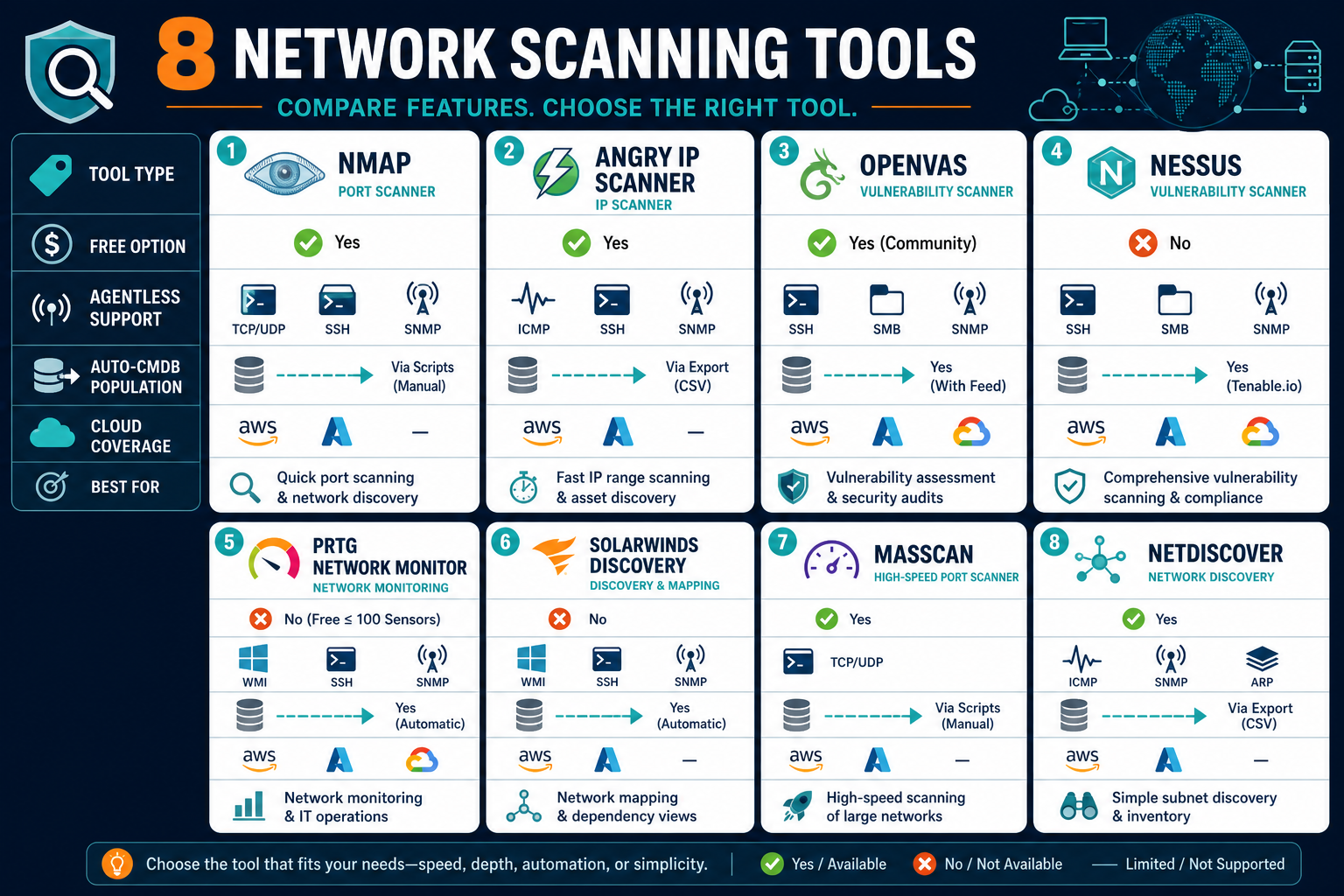
| Tool | Type | Free Option | Agentless | Auto-CMDB | Cloud | Best For |
|---|---|---|---|---|---|---|
| Virima | Discovery Platform | Demo available | Yes (WMI/SSH/SNMP) | Yes — auto-built | AWS, Azure | Enterprise IT ops, CMDB, agentic IT |
| Nmap | Port Scanner | Yes — fully free | Yes (no creds) | No | Limited | Security audits, sysadmins |
| Nessus | Vulnerability Scanner | Limited (16 IPs) | Yes | No | Yes | Vulnerability management |
| OpenVAS | Vulnerability Scanner | Yes — fully free | Yes | No | Limited | Open-source security teams |
| Angry IP Scanner | IP/Port Scanner | Yes — fully free | Yes (no creds) | No | No | Quick subnet discovery |
| SolarWinds NPM | Network Monitor | 30-day trial | Yes | Partial (NPM only) | Limited | Network performance monitoring |
| Qualys VMDR | Cloud Security | No | Yes | No | Yes | Cloud vuln management |
| Wireshark | Packet Analyzer | Yes — fully free | N/A (passive) | No | N/A | Traffic analysis, troubleshooting |
#1: Virima — enterprise IT discovery platform
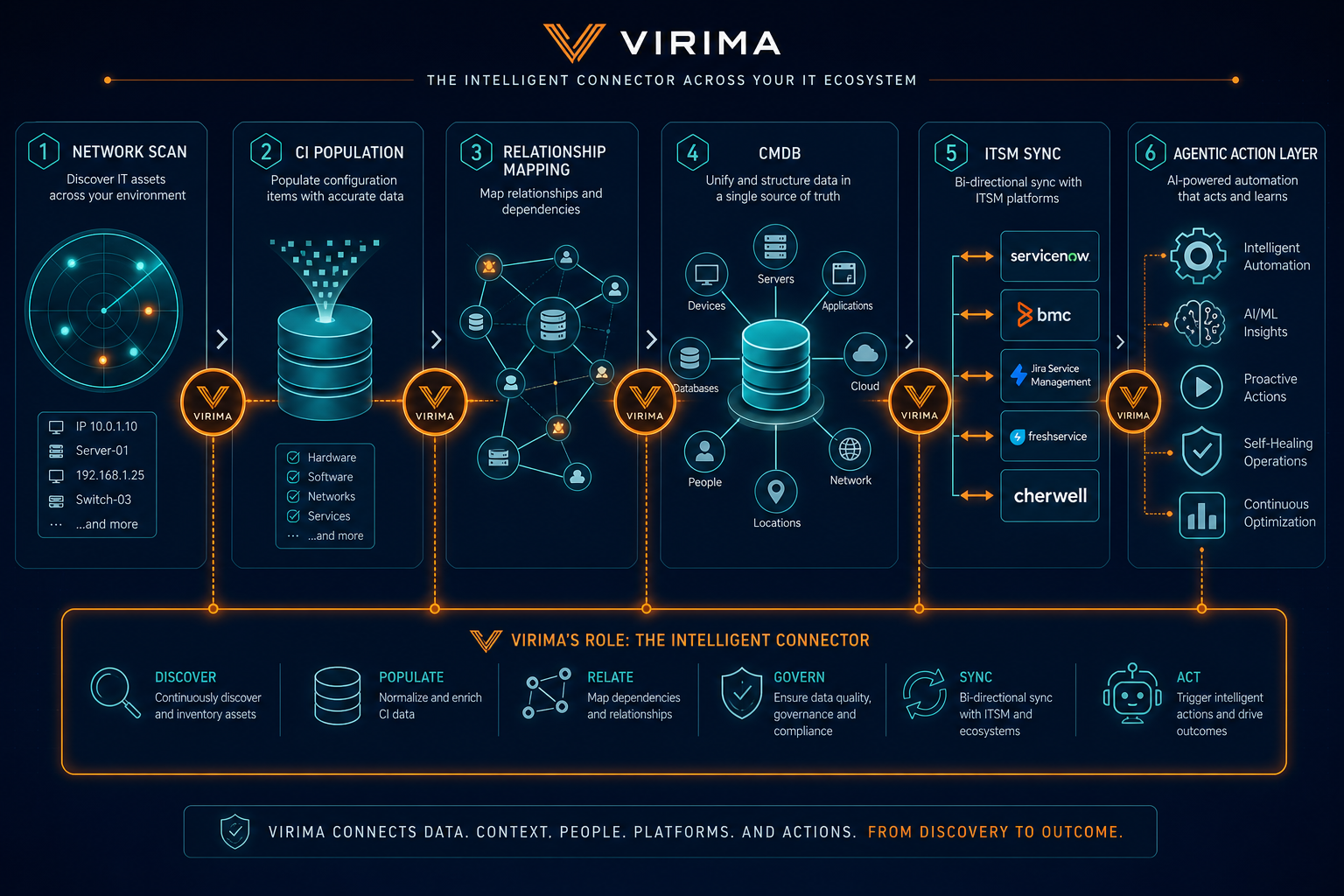
Virima uses agentless (credential-based WMI, SSH, SNMP), agent-based, and API-based scanning to discover assets across on-prem, cloud, and virtual environments. Where most network scanning tools end at a device list, Virima takes that data further. It auto-populates and maintains a CMDB — mapping CI relationships, tracking change history, and enriching records with vulnerability data from NIST’s National Vulnerability Database.
ViVID™ service maps sit on top of the discovery layer, showing which assets support which business services and what breaks downstream when a CI is affected. For IT teams managing ITAM programs, Virima also tracks hardware lifecycle, software license usage against actual installs, and contract expiration dates — all built from discovery data, without manual updates.
Virima syncs CI data bidirectionally with major ITSM platforms including ServiceNow, Jira Service Management, Ivanti, Halo, Xurrent, Hornbill, and TeamDynamix. The output is a maintained, dependency-mapped system of record that IT operations teams and AI agents can act on with confidence.
Pricing: Enterprise subscription. Contact Virima for pricing.
Best for: IT Directors, Infrastructure Engineers, Configuration Managers, and Security Engineers who need discovery to feed an accurate CMDB rather than produce a standalone scan output.
Standalone Answer — How is an enterprise discovery platform different from a standalone network scanner?
A network scanner discovers devices and ports. An enterprise discovery platform reconciles that data from multiple sources, populates a CMDB, maps service dependencies, and keeps CI records current through high-frequency discovery cycles. The difference is between a point-in-time snapshot and a live, governed system of record that operations and automation can rely on.
#2: Nmap (Network Mapper)
Nmap remains the most widely regarded free network scanning tool for security professionals and sysadmins. It supports host discovery, port scanning, version detection, OS fingerprinting, and scripted checks through the Nmap Scripting Engine. Output is configurable in multiple formats and integrates with other security tooling through standard XML. The command-line interface requires practice but covers more scan types than any other free option available today.
Pricing: Free and open source (nmap.org).
Best for: Security engineers, penetration testers, and network administrators running point-in-time audits.
Limitation: Produces scan output but does not populate a CMDB or feed asset lifecycle workflows.
#3: Nessus by Tenable
Nessus is one of the most widely deployed vulnerability scanners in enterprise security programs. Named a 2025 Gartner Peer Insights Customers’ Choice for Vulnerability Assessment, Nessus identifies misconfigurations, unpatched software, and known CVEs across networked assets. Its plugin library exceeds 70,000 checks. The free Nessus Essentials tier covers up to 16 IPs; Professional and Expert editions add unlimited scanning and compliance frameworks.
Pricing: Free tier available (Essentials, 16 IPs). Paid tiers on subscription — contact Tenable for current pricing.
Best for: Security engineers and compliance teams running structured vulnerability identification programs.
Limitation: Security-first output. No CMDB population or service dependency context.
#4: OpenVAS (Open Vulnerability Assessment System)
OpenVAS, maintained by Greenbone, is a free open-source vulnerability scanning framework used widely in security research. It uses a regularly updated feed of more than 50,000 Network Vulnerability Tests and supports both unauthenticated and authenticated scanning modes. Setup requires technical configuration, and scan speed on large environments can trail commercial alternatives.
Pricing: Free and open source (greenbone.net). Commercial support requires a Greenbone subscription.
Best for: Security-focused teams with the technical capacity to manage their own scanning infrastructure.
Limitation: No CMDB integration. No commercial support without additional Greenbone licensing.
#5: Angry IP Scanner
Angry IP Scanner is a lightweight, cross-platform free IP network scanner. It pings IP ranges, identifies live hosts, resolves hostnames, and reports open ports. Results export to CSV, XML, and other formats. Setup takes minutes and requires no credentials — which also means discovery depth is limited to what is visible without authentication.
Pricing: Free and open source.
Best for: Sysadmins running quick subnet checks or verifying a specific IP range before change windows.
Limitation: No authentication, no service fingerprinting, no integration with ITSM or asset management systems.
#6: SolarWinds Network Performance Monitor (NPM)
SolarWinds NPM monitors network performance and automatically discovers devices as they join the network. It excels at bandwidth usage tracking, device health visibility, and network capacity planning. Discovery is a secondary capability built to support monitoring, not to populate a CMDB or feed downstream IT operations workflows.
Pricing: Subscription-based; the network device scanner component started from $2,995 (as of 2025). Contact SolarWinds for current pricing. 30-day trial available.
Best for: Network engineers managing large distributed infrastructure who need performance data alongside inventory.
Limitation: Discovery data stays within NPM. No direct CMDB population or asset lifecycle tracking.
#7: Qualys VMDR
Qualys VMDR combines asset discovery, vulnerability assessment, and prioritized remediation in a cloud-native platform. Its architecture removes the need for on-prem scanner appliances. Qualys uses both agent-based and agentless scanning with a maintained vulnerability knowledgebase.
Pricing: Enterprise subscription. Contact Qualys for current pricing.
Best for: Security teams that need cloud-scale vulnerability management with built-in prioritization and remediation tracking.
Limitation: Security and vulnerability focus. Does not populate a CMDB or provide service dependency context for IT operations.
#8: Wireshark
Wireshark is a free, open-source packet analyzer that captures and inspects network traffic flowing through a network interface. It decodes protocols down to the packet level and is widely used for network troubleshooting, performance diagnostics, and forensic traffic analysis. Wireshark does not probe IP ranges for hosts or ports — it observes traffic passively and cannot produce an asset inventory.
Pricing: Free and open source (wireshark.org).
Best for: Network engineers and security analysts diagnosing connectivity issues, latency, and suspicious traffic patterns.
Limitation: Passive capture only. Not a substitute for active scanning. Produces no asset inventory or CMDB output.
Free vs. paid network scanning tools: when to upgrade
The decision between free and paid network scanning software comes down to what you need after the scan.
Free tools like Nmap and Angry IP Scanner work well for targeted tasks: confirming what is listening on a specific host, running a port check before change windows, or building a quick map of a new subnet. They require technical skill to operate, but the output is reliable for point-in-time use cases.
Paid vulnerability scanners like Nessus and Qualys add threat intelligence, compliance reporting frameworks, and remediation workflow integrations that security programs need for ongoing operations rather than spot checks.
The gap shows up most clearly when IT operations teams evaluate their options. Most free and paid network scanner tools produce output — a report or a file — but do not integrate with the CMDB, ITSM, or IT asset management systems where that data needs to live. Teams end up importing CSVs manually, which creates the data accuracy problems that make CMDBs untrustworthy within months of initial deployment. Industry research shows only 25% of organizations get meaningful value from their CMDB investments — and stale discovery data is one of the primary drivers. A successful CMDB implementation depends on discovery data that stays current, not on scans imported once and forgotten.
Standalone Answer — What is the best free network scanning tool for enterprise environments?
Nmap is the most capable free network scanner available and suits security audits and point-in-time port checks. For enterprises that need scan data to populate a CMDB or feed IT operations workflows, a standalone free scanner is not sufficient — the discovery output needs to flow into an asset management platform to remain operationally useful.
Enterprise teams should evaluate total cost, not license cost alone. The labor required to manually maintain a CMDB after running free scans typically exceeds the cost of a discovery platform that handles that work through high-frequency discovery cycles.
The Scan-to-CMDB Gap Most Network Scanning Tools Leave Open
Network discovery and network scanning address related problems, but they are not the same discipline. A network scanner tells you what is on the network at a point in time. A discovery platform tells you what is on the network, how it is configured, what it connects to, who owns it, and what changed since the last scan.
That gap becomes a business problem in situations like these:
- Incident triage: A critical server goes offline and no one can identify which applications depended on it before the incident.
- Change risk: A change is approved without a reliable picture of the blast radius of the proposed modification.
- Compliance audit: Evidence of software license coverage across the estate cannot be produced without a current asset record.
- Agentic IT: Gartner predicts 40% of enterprise apps will feature task-specific AI agents by 2026, up from less than 5% in 2025. Those agents need accurate CI data before taking autonomous actions on infrastructure.
Most network scanning tools — including the strongest paid options — are not built to answer those questions. They capture a discovery event but do not maintain a system of record. Change risk intelligence is only reliable when the CMDB it queries reflects what is actually running, and that requires a discovery-sourced data layer, not a scan report filed monthly.
Virima’s IT discovery capability runs agentless, agent-based, and API-based scans on schedule or on demand, feeding CI data, relationship maps, and NVD-based vulnerability enrichment into a single CMDB without manual intervention. When incident response depends on knowing which assets connect to a failing service, that difference matters. See how incident management improves when root cause analysis runs against accurate CI data.
Frequently Asked Questions
Why does CMDB data go stale so quickly after a network scan?
Most network scanning tools run on a schedule — monthly or quarterly. Between scans, assets are added, removed, reconfigured, and migrated with no update to the CMDB. The database reflects what existed at the last scan, not what exists now. Discovery platforms that support high-frequency discovery cycles address this by refreshing CI records on a schedule that matches the rate of change in the environment, not a calendar date.
How often should IT teams run network scans in enterprise environments?
Security teams typically run vulnerability scans weekly or after significant infrastructure changes. For CMDB accuracy, scan frequency should match the rate of change in the environment. Organizations with active cloud deployments or frequent server provisioning need higher discovery frequency than those with stable on-prem estates. Most enterprise teams find that scheduled discovery supplemented by targeted scans after change events provides acceptable CI data freshness for both operations and compliance.
How does Virima differ from a traditional network scanner?
Traditional network scanners output a list of discovered assets. Virima takes discovery further: it reconciles scan data from agentless, agent-based, and API sources; auto-populates the CMDB with CI records and relationships; enriches those records with NVD-based vulnerability data from the NIST National Vulnerability Database; and syncs bidirectionally with ITSM platforms including ServiceNow, Jira Service Management, Ivanti, and Halo. See how this connects to IT governance at scale.
Can free network scanning tools meet enterprise compliance requirements?
Free tools like Nmap and OpenVAS gather the raw data that compliance frameworks reference, but they do not produce the audit-ready reports, evidence trails, or ongoing monitoring that enterprise compliance programs require. Frameworks including PCI-DSS, SOX, and ISO 27001 call for demonstrable asset tracking and vulnerability management processes with documented evidence. Free scanning tools typically require significant additional tooling and manual effort to meet those requirements at enterprise scale.
What is the difference between agentless and agent-based network scanning?
Agentless scanning uses credentials (WMI, SSH, SNMP) to connect to devices remotely without installing software on the endpoint. Agent-based scanning deploys a lightweight software agent on each endpoint, which collects and reports data locally. Agentless scanning is faster to deploy and requires no endpoint changes; agent-based scanning typically captures deeper hardware and software data for managed endpoints. Enterprise discovery platforms like Virima support both methods alongside API-based collection for cloud and third-party systems.
Choosing among the best network scanning tools in 2026 depends on what job you need the data to do. Security teams auditing open ports and CVEs have different requirements than IT operations teams that need a maintained, relationship-mapped CMDB as the foundation for change management, incident triage, and agentic workflows. If your environment has grown beyond what a scan report can manage, schedule a demo to see how Virima turns discovery data into the operational foundation your team needs.
Discover Everything. Know the Impact. Act with Confidence.