I Paused Our Automation Program: Here’s Why and What We Fixed First

When a CIO pauses an IT automation program mid-deployment, it is almost always a data problem. Automated remediation rules are only as safe as the CMDB dependency maps they execute against — and when those maps are stale, the automation does not fail; it succeeds at taking the wrong action. This is the account of a pause called on one specific finding: three of fourteen rules would have triggered on outdated dependency data and extended incidents rather than resolving them.
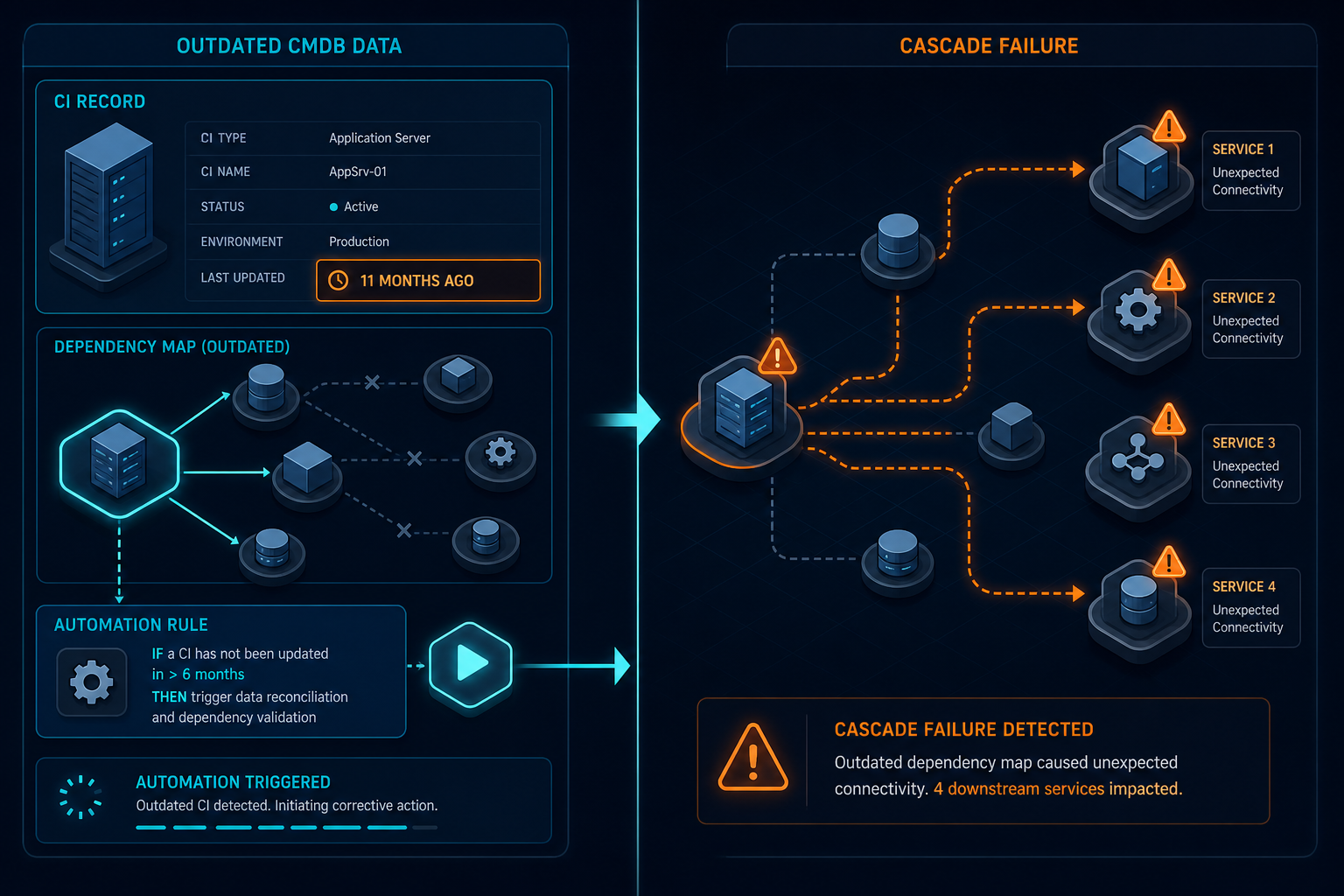
My reason was specific. In staging validation, three of the fourteen automated remediation rules we had built would have triggered on stale dependency data and would have taken the wrong corrective action — not a minor error, but actions that would have extended incidents rather than resolving them. One would have restarted a shared service that was actually healthy, cascading into four downstream applications that depended on its running state.
I called the pause the day that finding came back.
What the automation program was supposed to do
The initiative covered fourteen classes of infrastructure incidents that occurred frequently enough to have well-documented runbooks: disk space thresholds, service restart scenarios, connection pool exhaustion, certificate expiry warnings, and similar patterns. Each had a remediation sequence that an on-call engineer would execute manually — steps that a trained engineer could complete in 8–12 minutes, but that at 3 AM on a Friday required waking someone up.
The proposal: automate the detection and remediation of all fourteen incident classes, with human escalation if the automation failed to resolve within a defined threshold. Estimated benefit: 340 engineer-hours per year in eliminated on-call interruptions, an estimated 22-minute reduction in average MTTR for the automated incident classes, and removal of 14 repetitive tasks from the on-call rotation. Industry analysis, including research on CMDB data accuracy in enterprise automation deployments, consistently identifies stale dependency data as a leading cause of automation failures — a gap invisible until production.
The business case was approved. Development took five months. We moved to staging validation in month six.
What staging validation found
Staging validation ran the fourteen remediation rules against a simulated incident scenario for each class, using the live CMDB as the data source. The validation team then ran a parallel fresh discovery scan of the infrastructure segments the automation would operate on, and compared the automation’s intended actions against what the discovery scan showed the infrastructure actually looked like. This type of documentation-vs-reality gap is one of the most common failure patterns in automation readiness. The staging sweep is where those gaps surface.
Automated remediation sequences execute against an assumed model of the infrastructure — which services exist, what depends on what, and how many downstream systems will be affected by a restart or flush. When CMDB dependency data is stale, the automation does not throw an error. It successfully executes a sequence designed for infrastructure that no longer exists. The failure mode is not a crash; it is a confident, incorrect action.
Three of the fourteen rules showed critical divergence.
The connection pool recovery rule (Rule 7) would restart a specific database connection pool service when utilization exceeded 85%. The CMDB showed the service had 4 downstream dependents. The discovery scan found 11. The remediation sequence had been written for a 4-dependent restart, which included a 90-second notification delay. The actual 11-dependent environment required a 4-minute coordinated notification sequence before restart. Without that adjustment, the restart would have triggered 7 application failures without adequate warning time.
The cache invalidation response rule (Rule 11) would flush and rebuild a caching layer when a specific error pattern appeared. The CMDB dependency map showed the cache as independent of the transaction processing pipeline. The discovery scan showed a dependency added 8 months earlier, during a performance optimization project that had not updated the CMDB. Flushing the cache during active transaction processing would have caused a 2–3 minute processing gap — acceptable as a brief interruption in isolation, but catastrophic if it coincided with peak transaction volume.
The service restart trigger (Rule 14) was the most concerning. This rule would restart a shared middleware service on an alert threshold. The CMDB showed the service as a standalone component. Discovery showed it as the root dependency for four other services. The restart sequence had no coordination logic for those four services because, as far as the CMDB was concerned, they did not depend on it. A restart under this rule would have taken all four services down simultaneously.
Before your automation goes live, see how Virima’s continuous discovery keeps dependency maps current. See how it works
| Why does CMDB accuracy directly determine whether IT automation is safe to deploy? |
|---|
| Automated remediation sequences are written against a specific understanding of the infrastructure — which services depend on what, how many downstream systems will be affected, what notification sequences are required. If the CMDB data that describes those dependencies is stale, the automation executes based on a model of the infrastructure that no longer matches what is running. The automation does not fail — it succeeds at doing the wrong thing. |
What the pause cost
I called the pause the day that finding came back. The program entered a hold state pending a full CMDB data quality remediation for all infrastructure segments the fourteen rules would operate on.
Direct cost of the pause: $280,000 in deferred engineering ROI (the benefit that was delayed by six months), $60,000 in additional CMDB remediation work that had not been in the original project budget, and — harder to quantify — significant credibility loss with two stakeholders who had made commitments to the board based on the original timeline.
One of them was annoyed with me for several months. I understood why. I would have made the same case he was making if I had been in his position. But I had run the scenario: if Rule 14 had gone live and triggered during a high-traffic period, the four-service cascade would have caused an estimated 90-minute outage affecting $230,000 in transaction processing. That outcome would not have been framed as a data quality problem. It would have been framed as CIO negligence in deploying untested automation.
The $280,000 of deferred ROI was the right trade for avoiding that scenario. The calculus: weigh the cost of delay against the cost of a production failure caused by acting on stale data. Making that trade-off explicit — in dollar terms, before go-live — converts a political debate into a financial decision.
What we fixed
The remediation program ran for eight weeks — consistent with the 6–10 weeks typically required for automation-readiness CMDB data quality work at this scale. It covered four work streams (all figures are illustrative scenario data from this deployment):
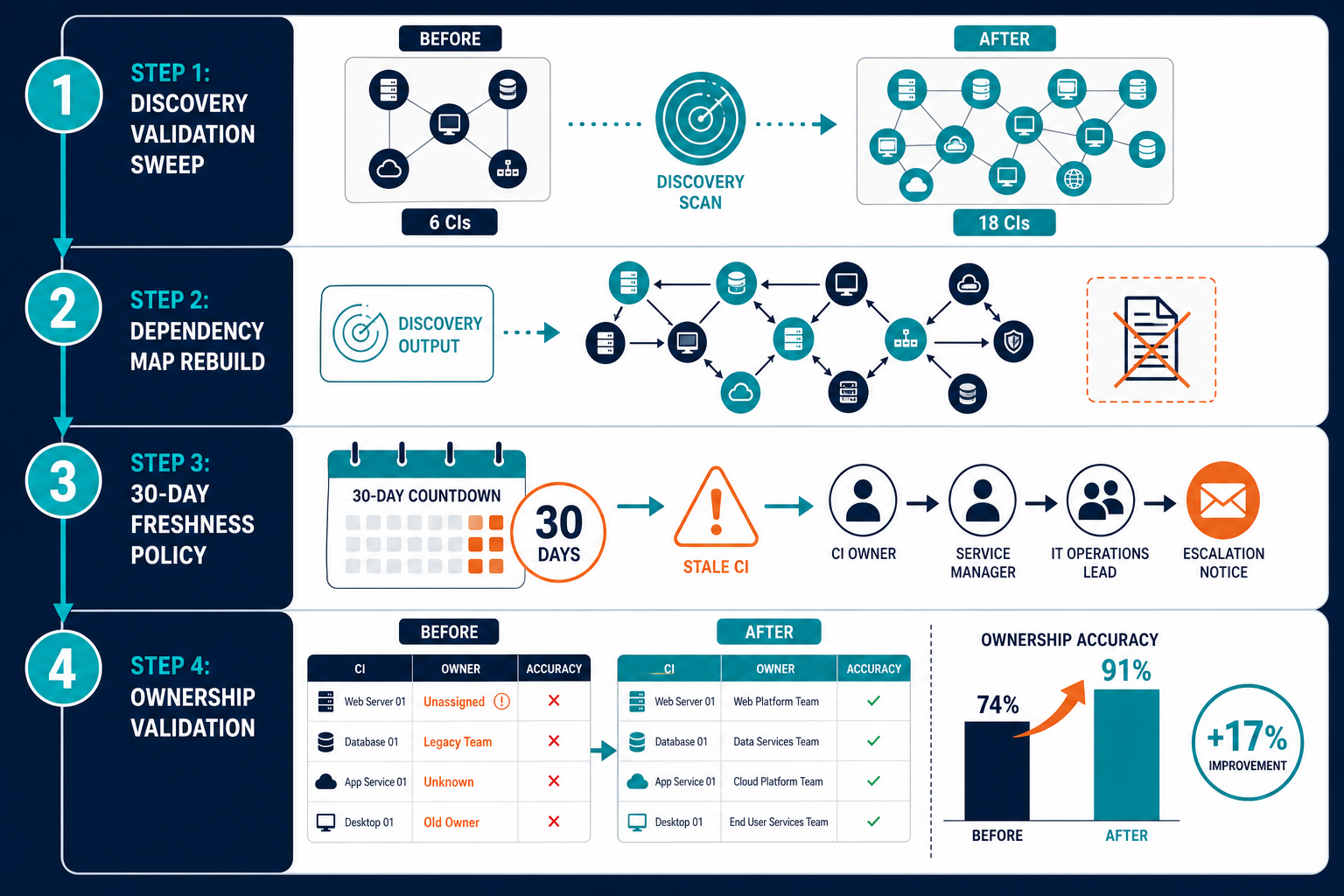
- Discovery validation sweep — We ran Virima’s agentless IT discovery across all infrastructure segments the automation would operate on. Segments scanned: 847 CIs. New dependencies found: 134. Phantom records removed: 61. Net CMDB accuracy improvement: from an estimated 74% to 91% coverage for the automation-relevant segments.
- Dependency map rebuild — For each of the fourteen automation rules, the dependency map was rebuilt from discovery output rather than from CMDB records. Four rules required significant revision. We confirmed two rules were safe as originally written. Eight rules required minor adjustments to notification sequences and coordination logic.
- Freshness policy implementation — We established a policy requiring that any CI record used as a decision input for automated remediation must have been discovery-validated within 30 days. CIs older than 30 days would trigger an alert and require manual review before the automation could act. This is the practical application of what continuous CMDB discovery enables — the automation itself signals when the data underneath it has drifted.
- Ownership validation — CI ownership records for all 847 automation-relevant CIs were validated against current team assignments. 23% required updates — team changes, role transitions, and three cases where the listed owner had left the organization.
| How do you prevent CMDB data from drifting after automation goes live? |
|---|
| A 30-day CI freshness policy creates a self-enforcing data quality mechanism: any automated remediation rule that requires CI data older than 30 days escalates to human review instead of executing autonomously. This turns the automation itself into a data quality signal — when CMDB records drift, the automation stops acting and flags the gap for correction rather than proceeding on outdated information. |
| What CMDB quality is needed before deploying IT automation? |
|---|
| Four prerequisites: a discovery-sourced scan of all relevant infrastructure (target: 90% CI coverage for execution-authority automation, 80% for recommendation-only), a dependency map rebuild from discovery output rather than documentation, a freshness policy capping CI age at 30 days for action-relevant records (60 days for recommendations), and an ownership validation confirming escalation contacts are current. These steps typically take 6–10 weeks to achieve and are the difference between automation that works and automation that fails with confidence. |
What automation looked like after the fixes
Twelve of the fourteen rules went live six months after the pause. Rule 7 and Rule 11 required architectural changes beyond the scope of the remediation program — they went into a separate backlog.
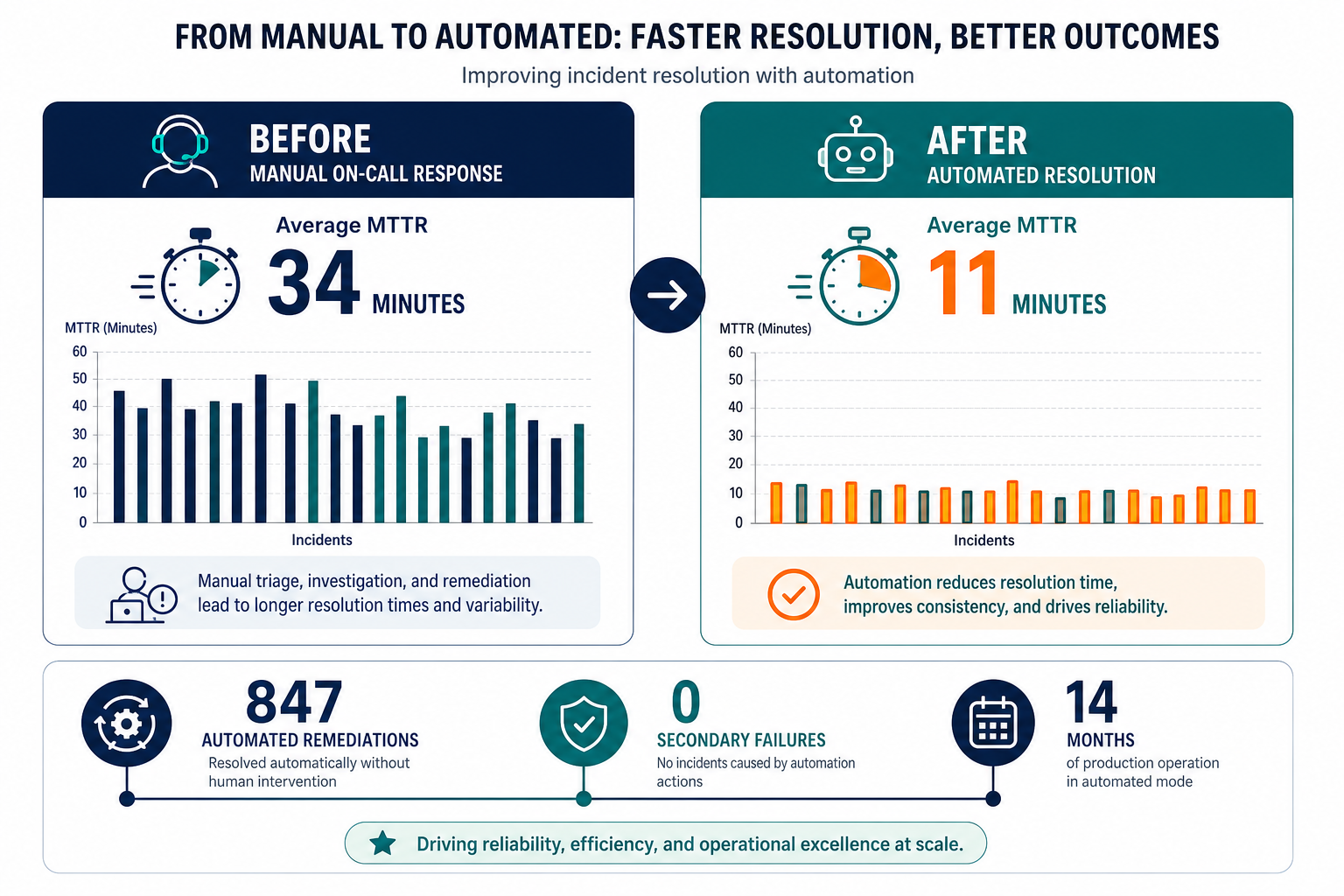
The twelve live rules have operated for fourteen months. In that time: 847 automated remediations executed, 3 escalated to human intervention, 0 caused secondary failures. The average MTTR for automated incident classes dropped from 34 minutes (manual response) to 11 minutes (automated).
The two rules that would have caused problems went live after a separate architecture change that addressed their fundamental design issues — not just their data quality issues. They have been running without incident for six months.
Trusted Runtime Truth — the requirement that the data driving automated decisions must be live, discovery-sourced, and explainable — was not a concept I had articulated before the pause. It is what the pause taught me. An automation system acting on data that accurately describes last year’s infrastructure is not a risk management tool. It is a liability with a launch date.
For CIOs evaluating automation initiatives and wondering whether the data foundation is ready, the evaluation framework has to happen before go-live, not after the first production incident.
If your team is planning an IT automation deployment and the CMDB data question is not yet answered, that answer determines whether your automation acts as a risk management tool or as a liability. See how Virima’s automated IT discovery keeps CI records and dependency maps current without manual effort — and use the four-step framework from this account to pressure-test your data foundation before committing to the build. Schedule a readiness conversation with the Virima team.