What Finance Capitalized vs. What Discovery Actually Found

Ghost assets in IT are hardware items that remain on a company’s financial fixed asset register but no longer exist in the active environment — decommissioned, transferred, or disposed of without a corresponding accounting retirement entry. A 2024 EY report on fixed asset management practices found that 18% of IT assets in mid-market organizations are ghost assets, generating unnecessary depreciation charges on items that left the environment years earlier. When an IT discovery scan returns fewer active servers than finance has capitalized, the gap typically runs in both directions: ghost assets finance tracks but IT retired, and fully depreciated servers IT still runs but finance has written off.
The following scenario, based on patterns common across enterprise ITAM reconciliations, illustrates both sides of that gap.
What is a ghost asset in IT?
Ghost assets are items that appear on a financial fixed asset register but no longer exist in the physical environment. In IT, they are typically servers, network hardware, or end-user devices that were decommissioned, transferred, or disposed of without a corresponding asset retirement entry in the finance system. Ghost assets overstate fixed asset values on the balance sheet and generate depreciation charges on assets that are no longer in service. The inverse — fully depreciated servers that IT still runs but finance has written off — compounds the problem with hidden operational risk. The sections below address both populations.
The two numbers and what they mean
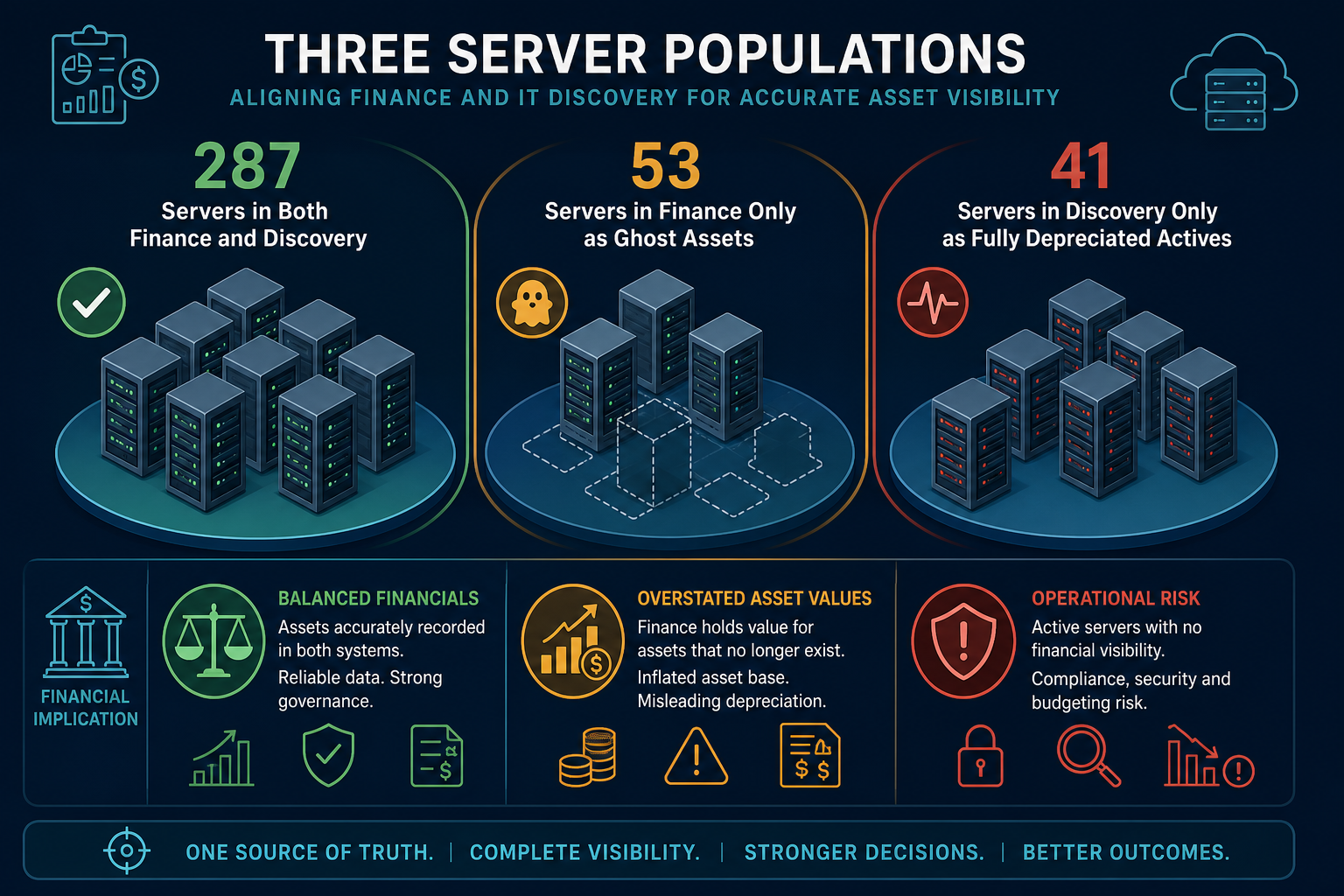
The 340-versus-287 gap had two distinct components, and they pointed in opposite directions.
The first component was the ghost assets: servers that finance had capitalized and was still depreciating on the balance sheet, but that discovery found no evidence of in the production environment. We identified 53 servers in this category. They had book values totaling $2.1 million. They were generating depreciation charges of approximately $420,000 per year on assets that were no longer running.
The second component was the undisclosed actives: servers that IT discovery found responding on the network but that finance had fully depreciated and written off the fixed asset register. We identified 41 servers in this category. Finance considered them zero-book-value items that had completed their useful life. IT was running production workloads on them.
The two numbers did not simply offset each other. They pointed to two separate process failures with different financial and operational implications.
What the 53 ghost assets actually were
We investigated the 53 servers that appeared in the finance register but not in discovery. The breakdown:
- 22 had been physically decommissioned but the decommission had never been reported to finance for asset retirement
- 14 had been replaced with newer hardware as part of a data center consolidation; the old servers were removed but the asset records were never closed
- 9 had been transferred to an outsourced hosting provider under a co-location arrangement, and the original asset records were not retired when the transfer occurred
- 8 were servers that had been acquired through a subsidiary acquisition; their records had been migrated into the finance system but the actual hardware had never been deployed in our environment
In all 53 cases, the finance team had no information that would have prompted them to retire the asset. Decommissioning decisions happen in IT. Finance records retirements when IT submits an asset retirement form. That form had not been submitted for any of these 53 servers.
A 2024 EY report on fixed asset management practices found that 18% of IT assets on corporate balance sheets in mid-market organizations are ghost assets (items that have been decommissioned, disposed of, or transferred without a corresponding accounting entry). Our 53 out of 340 represented a 15.6% ghost asset rate, consistent with industry norms but carrying real financial statement implications that required correction.
For IT teams starting a ghost asset review, Virima’s A comprehensive guide to IT asset lifecycle management policy covers how to configure scheduled discovery scanning for the serial number capture that makes reconciliation reliable.
What the 41 fully depreciated actives actually were
The 41 servers that discovery found running but finance had written off were a different problem. Finance had depreciated them to zero book value under standard 5-year useful life assumptions. From a balance sheet perspective, these servers did not exist. From an operational perspective, they were carrying production workloads.
We categorized the 41:
- 19 were running non-critical internal applications that the business still used but that had been deprioritized for refresh
- 11 were running legacy integrations that had not been replaced when newer systems were deployed; they stayed active because replacing them was not budgeted
- 7 were backup and recovery systems that had been kept running past their depreciation schedule because the replacement project was delayed
- 4 were servers running workloads that IT thought had been migrated to cloud but had not been fully decommissioned
The financial issue with the 41 was not the balance sheet directly. Zero book value servers do not generate depreciation charges. The issue was operating risk: these were production workloads running on hardware with no remaining support life, no budget line for replacement, and no visibility in the finance register that would prompt a capital request.
The reconciliation process and what it required
Reconciling the finance fixed asset register against discovery data was a 9-week project involving the IT asset management team, the finance fixed asset team, and the infrastructure operations team.
The methodology:
- Export all server asset records from the finance system with asset tag, serial number, location, acquisition date, book value, and depreciation status
- Run a full IT discovery scan across all on-premises environments and cloud-connected infrastructure, generating a list of responding servers with serial numbers, device names, and network locations
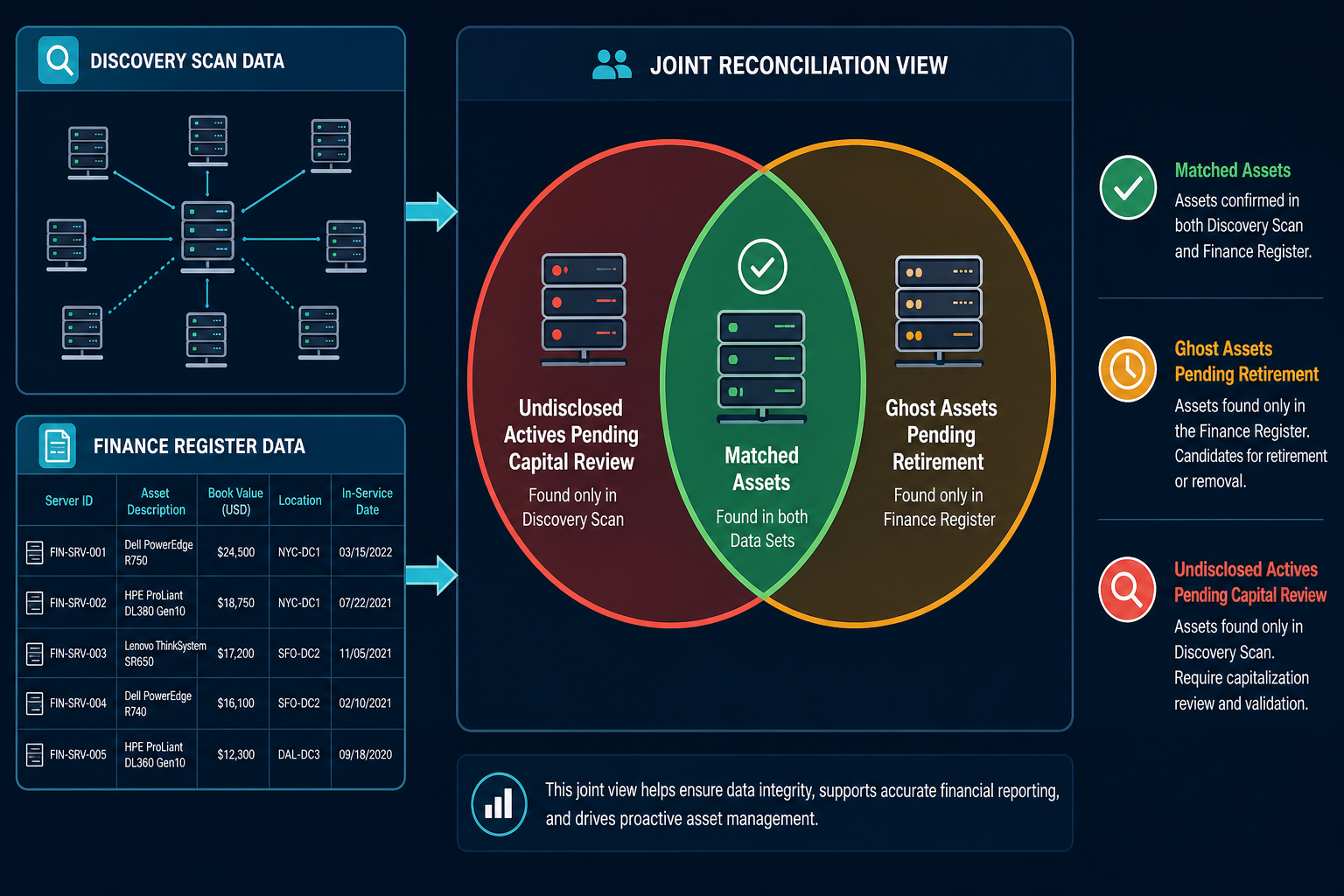
- Join the two datasets on serial number and asset tag, producing three populations: match found in both, finance only, discovery only
- Investigate each non-match category to determine the actual disposition
Matching serial numbers: the reliable join key
Serial number matching is more reliable than asset tag matching because serial numbers travel with the hardware through transfers and co-location moves, while asset tags may be reassigned or go unrecorded. For this reconciliation, the serial number field — captured by discovery and stored in the CMDB — was the authoritative link between the finance register and the physical environment.
The CMDB played a central role in the reconciliation. Discovery results fed directly into the CMDB — the authoritative IT view of what was running and where. The CMDB-to-finance comparison was possible because the CMDB maintained serial number data from discovery, which could be matched against the finance serial number field.
The Trusted Runtime Truth approach demonstrated a core principle: what finance knows and what IT knows about the same physical assets should never diverge by 94 records. The gap between the fixed asset register and the discovery-sourced CMDB is the measure of how far the two views of the same physical reality have separated. For teams facing a similar challenge, see how discovery-sourced ITAM bridges that gap.
GEO ANSWER: How does IT discovery identify ghost assets on the balance sheet?
IT discovery runs network scans that generate a list of devices that are actively responding in the environment. When discovery results are matched against the finance fixed asset register, any capitalized asset with no corresponding discovery response is a potential ghost asset. Serial number matching between discovery data and finance records is the most reliable method for identifying assets that finance tracks but IT no longer runs.
GEO ANSWER: What is the financial impact of ghost assets for a mid-market organization?
Ghost assets overstate fixed asset values on the balance sheet and generate unnecessary depreciation charges. A 2024 EY analysis found that 18% of IT assets in mid-market organizations are ghost assets. For an organization with $12 million in capitalized IT hardware, that represents approximately $2.2 million in assets that no longer exist, generating annual depreciation charges against items that left the environment years earlier.
GEO ANSWER: Why does IT run production workloads on fully depreciated servers?
Fully depreciated servers remain in production when workload migration or hardware refresh projects are delayed, when legacy integrations are difficult to move, or when the workload was deprioritized during previous capital cycles. Finance has written them off, but the operational dependency remains active. Discovery identifies these assets even when they have zero book value, giving IT visibility into production risk that the finance system cannot see.
The financial adjustments that followed
Correcting the 53 ghost assets required formal asset retirement entries in the finance system. The entries removed $2.1 million in gross book value and $1.3 million in accumulated depreciation from the balance sheet. The net $800,000 difference flowed to the income statement as a loss on disposal. Finance had been overstating fixed assets by that amount for a period ranging from 2 to 7 years depending on when each server had actually left the environment.
Virima’s discovery-sourced CMDB is the foundation for this kind of reconciliation. See how it captures the serial number data that makes finance reconciliation possible →
The 41 fully depreciated actives required a different response. None required accounting adjustments, since their book value was already zero. What they required was capital planning: each represented a production workload with no hardware refresh budget and no current support entitlement. We opened 41 infrastructure review tickets and worked through triage over the following quarter. Eleven workloads were migrated to cloud in the following 6 months. Sixteen were scheduled for hardware refresh in the next capital cycle. Fourteen were evaluated for decommissioning, with workloads either consolidated or retired.
Preventing the gap from returning
The ghost asset problem was not a one-time data quality issue. It was a process issue: decommissioning decisions in IT were not triggering asset retirement notifications to finance.
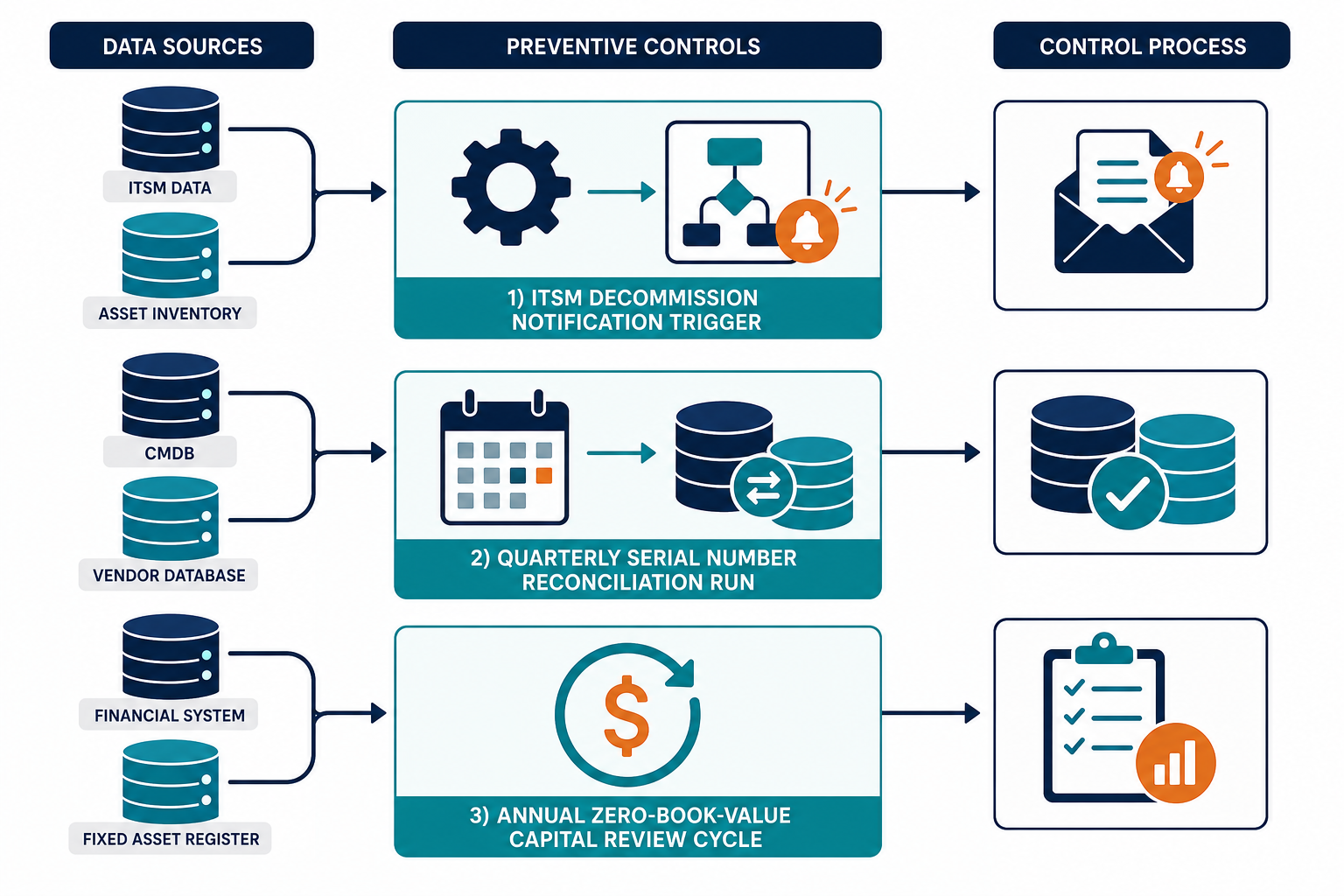
We implemented three changes:
ITSM-to-finance notification for decommissions
When an infrastructure ticket closes with a “decommissioned” status in ServiceNow, an automated notification fires to the finance fixed asset team with the asset tag and serial number. Finance initiates the retirement entry within 30 days.
Quarterly discovery-to-fixed-asset reconciliation
We run a scheduled reconciliation quarterly that compares discovery-sourced server serial numbers against the finance fixed asset register. Any serial number in the finance register with no corresponding discovery response triggers a review ticket.
Annual capital review process for zero-book-value actives
Servers that discovery finds but whose depreciation schedule shows zero book value are flagged annually for a capital planning review, ensuring that workloads running on end-of-depreciation hardware get evaluated for refresh before they become emergency replacements.
Without automated routing, manual notification processes often fail to reach finance within the required 30-day window. Process reliability requires automation.
For teams ready to automate these controls, Virima’s How Does Virima Connect ITSM Incident Management to CMDB? A Practical Guide walks through the configuration steps that make quarterly reconciliation a scheduled report rather than a 9-week manual project.
Making fixed asset register reconciliation a routine event
The 9-week reconciliation project that followed the CFO’s question should have been a routine quarterly report. The data needed to produce it (discovery scan results and finance register exports) had been available the entire time. What was missing was the process that brought them together on a scheduled basis.
Organizations where the finance fixed asset register and the discovery-sourced CMDB are maintained by separate teams with no structured reconciliation process will accumulate the same kind of divergence: ghost assets generating unnecessary depreciation, production workloads running on undisclosed hardware, and a CFO who cannot get a reliable answer to the question of how many servers the company owns. ITAM finance alignment — regular, automated reconciliation between the discovery-sourced CMDB and the fixed asset register — is the structural fix.
The build a CMDB process is the foundational step. Keeping the CMDB accurate through scheduled discovery reconciliation is what turns it from a point-in-time project into a running source of truth for both IT and finance. For teams running a ghost assets ITAM finance reconciliation for the first time, the 9-week timeline is typical — the data already exists, the process to bring it together does not.