Why ServiceNow CMDB Doesn’t Fit Mid-Market IT Teams – And What Does

ServiceNow CMDB alternatives for mid-market IT teams solve a fit problem, not a feature problem. ServiceNow’s CMDB is an enterprise platform requiring 6–12 months to implement and a dedicated admin team to maintain — constraints mid-market IT organizations with 2–5 person infrastructure teams typically cannot meet. This guide evaluates what separates purpose-built mid-market CMDB platforms from scaled-down enterprise tools, and what five criteria actually predict post-go-live accuracy.
What ServiceNow’s CMDB actually delivers
Before the gap, here’s what ServiceNow’s CMDB is genuinely good at.
Workflow integration at depth
ServiceNow’s CMDB is native to the ServiceNow platform. CI data flows directly into incident management, change management, problem management, and asset workflows without integration work. For organizations already running the full ServiceNow suite, that native connectivity is a real operational advantage.
IRE for multi-source reconciliation
The ServiceNow Identification and Reconciliation Engine handles CI population from multiple sources — Discovery, integrations, manual records — and applies reconciliation rules to manage conflicts. In mature ServiceNow environments, this produces a reasonably accurate single system of record.
CMDBHealth gives visibility into data quality — when you invest in maintaining it
ServiceNow CMDBHealth tracks CMDB completeness and staleness at the CI class level. Organizations that maintain it have a visible dashboard of data quality across their estate.
Enterprise ecosystem
ServiceNow has a deep partner ecosystem, a large professional services community, and well-documented implementation methodology. For enterprise organizations with the resources to deploy it correctly, that ecosystem is valuable.
These are genuine strengths. They are also the reason ServiceNow commands enterprise pricing, requires enterprise-scale implementation, and assumes enterprise-scale resourcing to operate effectively.
What are the limitations of ServiceNow CMDB for mid-market IT teams?
ServiceNow CMDB is designed for enterprise-scale environments with dedicated implementation resources, significant licensing budgets, and ongoing admin expertise. Mid-market IT teams typically face three practical barriers: implementation timelines of 6–12 months, licensing costs that assume enterprise headroom, and a Discovery configuration requirement that needs ongoing expert maintenance to remain accurate.
Where ServiceNow CMDB breaks down for mid-market
Here is where the fit problem surfaces — not in the product’s features, but in what it takes to make those features work for an organization that is not running a 10,000-node global estate with a dedicated ServiceNow admin team.
Implementation timeline
A production-ready ServiceNow CMDB implementation typically runs 6 to 12 months from project kick-off to usable data. That timeline includes scoping Discovery, defining CI classes, configuring reconciliation rules, mapping relationships, and validating data quality before the CMDB can reliably feed downstream workflows. Mid-market IT teams rarely have the project bandwidth or the budget for that runway. HDI’s State of the Service Desk research on IT team-to-employee ratios confirms mid-market teams operate without the dedicated project capacity enterprise implementations assume.
Discovery configuration overhead
ServiceNow Discovery is powerful, but it requires significant configuration to be effective. Defining which IP ranges to scan, which credentials to use, which CI classes to populate, and how to handle multi-source conflicts is ongoing maintenance work, not a one-time setup. In most enterprise environments, a dedicated Discovery admin handles this. In mid-market environments, that work falls to the same infrastructure engineer who is also handling everything else.
Licensing cost structure
ServiceNow’s pricing is designed around enterprise deployment. Mid-market organizations end up in one of two traps: paying for capacity they won’t use for years, or buying the minimum license that still exceeds what the team’s actual scale justifies.
Coverage gaps from partial Discovery scope
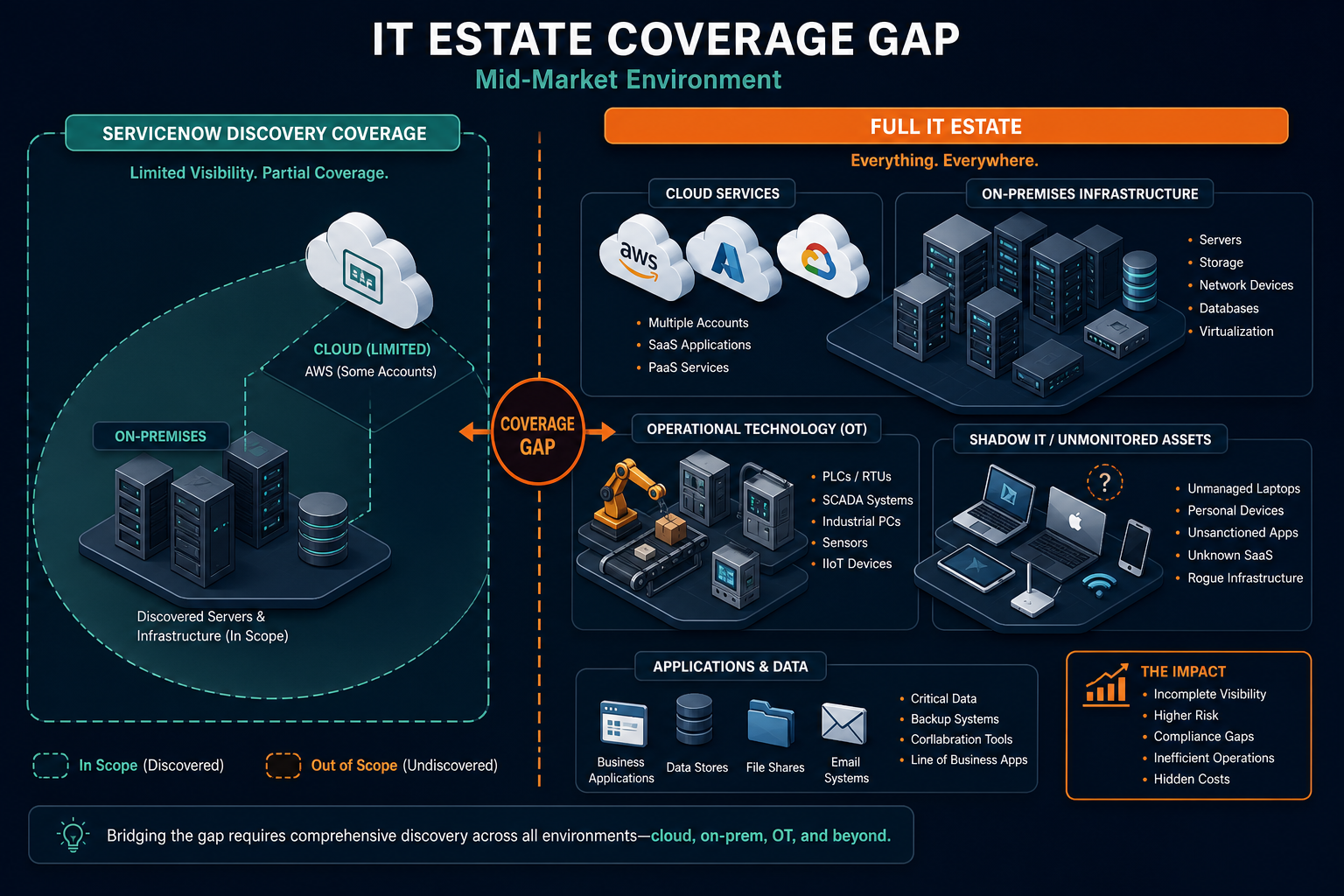
Because Discovery configuration is complex and resource-intensive, many mid-market ServiceNow deployments run Discovery against a portion of the environment — the well-documented datacenter assets, but not the full cloud estate, not the OT equipment, not the shadow IT that accumulated outside IT’s direct control. The CMDB that results is accurate for what it covers. What it covers is often less than what exists.
Why do mid-market IT teams struggle with ServiceNow CMDB?
The core issue is resource mismatch. ServiceNow CMDB assumes dedicated implementation resources, ongoing Discovery admin expertise, and an enterprise licensing budget. Mid-market IT teams with two-to-five person infrastructure teams typically cannot sustain the configuration and maintenance overhead required to keep a ServiceNow CMDB accurate, which undermines the workflows that depend on it.
What a mid-market CMDB evaluation should actually ask
The right evaluation framework for mid-market IT does not start with “does this tool have all the features ServiceNow has?” It starts with five questions that reflect the actual operating conditions of a mid-market IT team.
1. How long until the CMDB is producing usable data?
A six-month timeline is not acceptable for a team with immediate pressure — an agentic AI pilot to support, an audit to pass, or an active gap in change impact analysis that is causing incidents. The right target for mid-market is a CMDB producing actionable CI data within 30 to 60 days of deployment.
2. Does Discovery work out of the box, or does it require expert configuration?
Mid-market IT teams need discovery that covers the estate accurately without dedicated expertise to configure and maintain it. Multi-method discovery — agentless network scanning, agent-based collection, cloud API connectors for AWS and Azure — should be functional with minimal configuration, not a blank canvas that requires a skilled architect to make work.
3. Is the pricing right-sized for the actual estate?
Mid-market organizations managing 200 to 2,000 nodes should not be paying for a platform designed around 50,000-node global deployments. Discovery-scope-based pricing, with clear cost at the actual estate size, is the right structure.
4. Does it work with the ITSM platform already in place, or require replacing it?
Most mid-market IT teams already have an ITSM platform: Jira Service Management, Ivanti, HaloITSM, Xurrent, or TeamDynamix. A CMDB that requires migrating to the vendor’s own ITSM to unlock its native workflow capabilities is not built for the mid-market operating model. An ITSM-agnostic CMDB with bidirectional integration — working with whatever platform is already in place — is the requirement.
5. Who maintains it after go-live?
Enterprise tools require enterprise staffing. The right CMDB for mid-market should be maintainable by the infrastructure engineer who already owns discovery, not a separate platform specialist.
What should mid-market IT teams look for in a ServiceNow CMDB alternative?
Mid-market IT teams should evaluate CMDB alternatives on five criteria: deployment to usable data within 30–60 days; discovery accuracy without dedicated configuration overhead; pricing matched to 200–2,000 node estates; bidirectional integration with the ITSM already in use; and low ongoing maintenance burden for a small infrastructure team.
How the leading ServiceNow CMDB alternatives compare for mid-market
With those five criteria as the evaluation frame, here is an honest look at the platforms mid-market IT teams typically evaluate.
| Criterion | Virima | Device42 | ManageEngine ServiceDesk Plus | Freshservice |
|---|---|---|---|---|
| Deployment to usable data | 30–60 days | 60–90 days | 2–4 weeks (ITSM-first) | 1–2 weeks (ITSM-first) |
| Discovery without dedicated admin | ✅ Multi-method, low config | ✅ Strong discovery depth | ⚠️ Asset-focused, lighter discovery | ⚠️ Basic discovery, manual gaps |
| Pricing for 200–2,000 node estates | ✅ Scope-based | ⚠️ Node-based, mid-market viable | ✅ Competitive | ✅ Competitive |
| ITSM-agnostic integrations | ✅ Bidirectional, 7+ platforms | ✅ Multiple ITSM connectors | ❌ Own ITSM required for full CMDB | ❌ Own ITSM required for full CMDB |
| Low ongoing maintenance | ✅ Automated high-frequency discovery | ⚠️ Blueprint config required | ⚠️ Manual asset management | ⚠️ Limited CI freshness governance |
Virima
Virima is built for mid-market operating conditions — deployable in 30 to 60 days, maintainable by the infrastructure engineer who already owns discovery, and priced around actual estate size rather than enterprise headroom. Under the hood, that’s discovery-sourced Trusted Runtime Truth: a CMDB populated entirely from what multi-method discovery finds across the estate. Virima attaches source attribution, discovery method, and freshness timestamps to every CI — so teams reviewing a change request see current data, not what the CMDB said three months ago.
Introducing ViVID Service Maps surface service dependencies from discovery relationships. Users define which services they care about; Virima builds the dependency map from what discovery found.
Virima integrates directly with ServiceNow to enrich your CMDB with discovery-sourced ground truth, alongside JIRA Service Management, Ivanti, HaloITSM, Xurrent, Hornbill, and TeamDynamix — so mid-market teams keep the ITSM they already operate while adding Virima’s continuous discovery layer. Pricing is structured around discovery scope, not enterprise platform headroom.
Device42
Device42 is a well-regarded CMDB and IT discovery platform with strong application dependency mapping. It serves mid-market environments and covers on-premises, cloud, and network assets across a competitive discovery scope. Deployment typically runs 60 to 90 days with professional services engagement. The comparison with Virima centers on two dimensions: service mapping philosophy — Device42’s blueprint-based model requires manual service definition before maps produce useful output, while Virima’s ViVID maps derive service relationships from live discovery data — and ITSM integration breadth. Device42 supports several major ITSM platforms but requires integration configuration that Virima handles out of the box for Jira, Ivanti, HaloITSM, and others. For mid-market teams with strong in-house technical capacity, Device42 is a credible alternative.
ManageEngine ServiceDesk Plus
ManageEngine offers a combined ITSM and asset management platform at a price point designed for mid-market. Its CMDB capabilities are less deep than Virima or Device42 — the focus is ITSM workflow first, with CMDB as a supporting function rather than a primary data layer. Asset discovery is included but covers a narrower scope than purpose-built discovery platforms, and CI relationship mapping relies more on manual configuration than automated discovery. That gap means teams doing change impact analysis or audit prep will find the CI data layer thinner than they need. For teams where ITSM workflow efficiency is the priority and CMDB accuracy is secondary, it is a cost-effective option.
Freshservice
Freshservice is a popular mid-market ITSM platform with built-in asset discovery and a CMDB. Its strengths are UX, ease of deployment, and competitive pricing — initial setup typically runs one to two weeks. Its CMDB depth is lighter than purpose-built CMDB platforms: asset records are populated from discovery, but CI relationship mapping and freshness governance are limited. There is no equivalent to Virima’s per-CI source attribution or automated high-frequency discovery cycles. For teams where ITSM workflow efficiency matters more than CMDB data depth, Freshservice is worth evaluating — but teams with change management complexity or audit requirements will likely find the CI data layer insufficient over time.
The real comparison: what happens after go-live
The alternatives comparison above covers features at a point in time. The more important comparison happens six months after go-live.
A ServiceNow CMDB at month six in a mid-market environment typically looks like this: Discovery is running against the initially configured scope. The scope has not kept up with cloud sprawl or a server migration that happened in month three. CI records for assets added since go-live are either missing or manually entered and already stale. The team is maintaining the CMDB as a second job alongside their actual infrastructure work.
A Virima CMDB at month six in a mid-market environment looks like this: High-frequency discovery cycles are running continuously. CI records carry freshness timestamps. New assets discovered after go-live are added automatically. The infrastructure engineer reviews exceptions rather than maintaining records. The ITSM team is pulling CI data from the CMDB into change records and incident workflows without a separate reconciliation step.
The difference is not a feature gap. It is a resourcing assumption. ServiceNow assumes you have the people to maintain it. Virima assumes you do not and builds the maintenance into the product.
Is Virima a good alternative to ServiceNow CMDB for mid-market teams?
Virima is built for mid-market IT operating conditions — high-frequency discovery cycles, low configuration overhead, deployment in 30 to 60 days, and bidirectional integration with Jira Service Management, Ivanti, HaloITSM, Xurrent, and TeamDynamix. It delivers discovery-sourced Trusted Runtime Truth without the enterprise implementation overhead ServiceNow CMDB requires.
Making the right call for your team
ServiceNow CMDB is the right choice for a specific type of organization: large, well-resourced, already running the ServiceNow platform, and able to sustain the configuration and maintenance work that keeps it accurate. In that environment, it delivers real value.
For mid-market IT teams managing 200 to 2,000 nodes with a small infrastructure team and no implementation budget for a six-month project, the honest answer is that ServiceNow CMDB is not built for your operating model. The features are there. The resourcing assumption that makes them work is not.
That gap is why mid-market IT teams evaluating ServiceNow CMDB alternatives increasingly look to purpose-built platforms. The criteria that matter — deployment speed, discovery coverage without expert configuration, ITSM integration flexibility, and low ongoing maintenance burden — point to tools that start from the mid-market operating model rather than scaling it down from enterprise.
What K26 Is Really Telling IT Leaders About Their CMDB