Vendor Contracts Expiring With Nobody Tracking Them

Vendor contract expiration becomes an ITAM risk when procurement renewal processes run independently of IT discovery data. When auto-renewal notice windows close without discovery-verified install counts, organizations renew at list pricing without negotiating from actual usage — a gap that produced $94,000 in avoidable overspend and left 78 users running unlicensed software across 23 untracked contracts in one enterprise IT environment.
We discovered that one of our enterprise security tools had been running on expired entitlements for seven months when the vendor’s account team called to discuss renewal terms. The tool was active. Our users were accessing it. Our IT team had no vendor contract expiration record in our ITAM system. The procurement team had a spreadsheet entry showing the renewal notice date had passed, but nobody had connected that spreadsheet to any ITAM tracking record, any active install count, or any IT alert.
How we found 23 contracts in the same state
That security tool incident prompted a full contract audit. We asked procurement to export every active IT vendor contract with an expiration date in the preceding 24 months. We then matched that list against our IT asset management system to check whether each contract had a corresponding entitlement record with an accurate expiration date.
The results:
- 23 contracts had expired or entered auto-renewal within the previous 24 months without a corresponding update in ITAM
- Of those 23, 16 had auto-renewed under standard terms without any negotiation, at prevailing list pricing, without volume discount review
- 4 had expired outright, with the software still installed and running on devices across our estate despite having no current entitlement
- 3 had been manually cancelled by procurement without IT being notified, leaving 78 users on products that were no longer licensed
The total value of the 16 auto-renewals, calculated at list pricing versus what we estimated we could have negotiated with advance preparation, represented approximately $94,000 in avoidable overspend. The 4 expired-but-active products represented ongoing compliance exposure. The 3 cancelled-without-IT-notification products had left 78 users running software with no entitlement.
Virima adds new features to Virima ITAM Asset Discovery
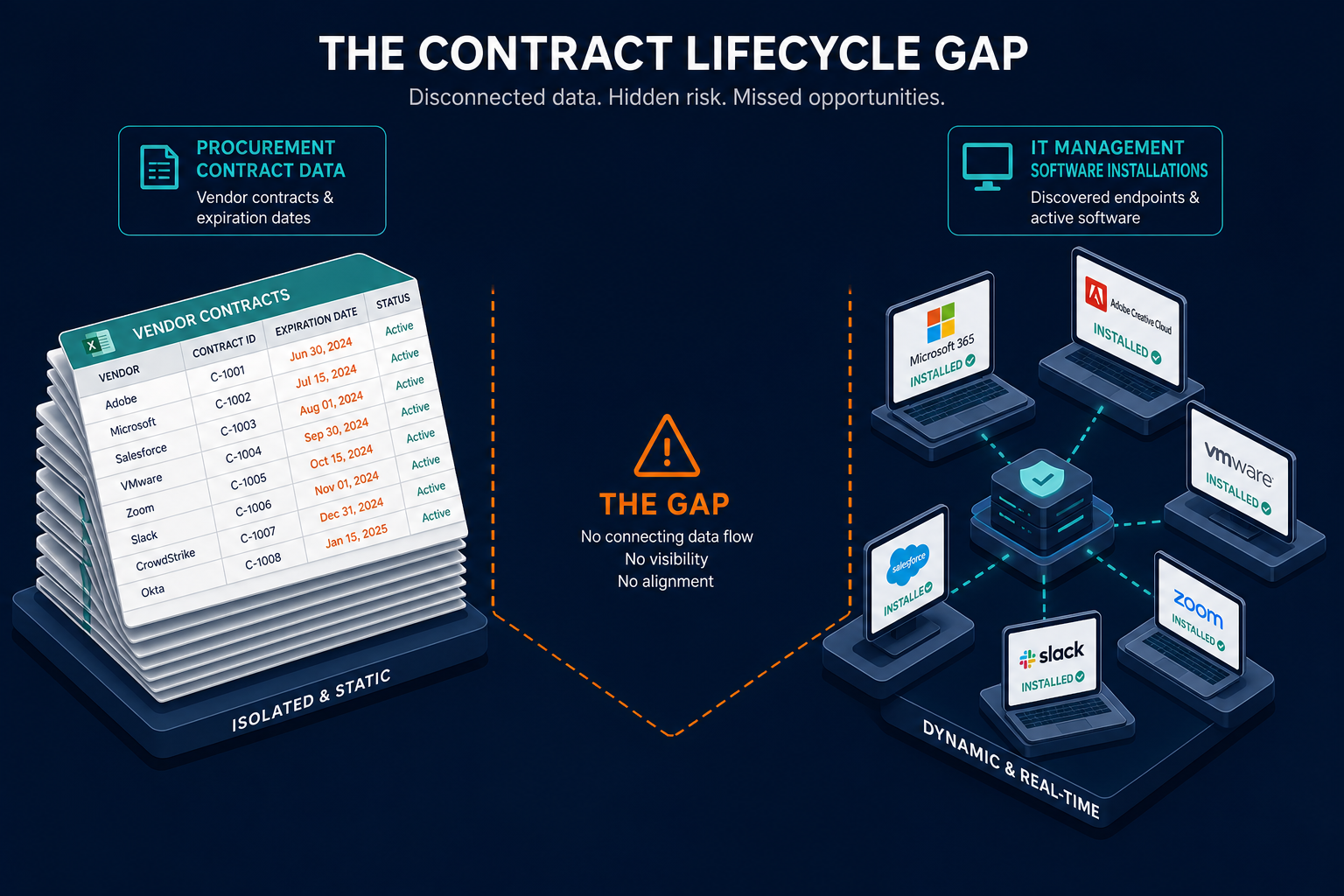
Why contract data living in procurement spreadsheets creates this problem
Vendor contracts expire without IT involvement when renewal reminders route to procurement and budget owners rather than IT asset managers. Without discovery-sourced install counts linked to contract expiration dates, IT has no mechanism to verify active installations against upcoming entitlement gaps — meaning software can run on expired licenses for months before a vendor audit surfaces the exposure.
Contract data and asset data belong in the same system. When they live in different places — contracts in procurement spreadsheets or a procurement platform and active installs in discovery and ITAM — nobody has a complete view of whether an active entitlement covers the active installs.
Our procurement team maintained a master contract spreadsheet with renewal dates, auto-renewal notice windows, and account manager contacts. They sent reminder emails 60 days before each renewal date. Those reminder emails went to the procurement lead and the business unit budget owner. IT was not on the distribution list.
When the reminder email arrived, procurement’s question was: do we want to renew this? The business unit’s answer was almost always yes, because nobody had asked the business unit to assess actual usage. So the contract renewed. IT never saw the transaction.
When IT discovery runs and finds software installed across the estate, it sees what is actually running. When that discovery data is matched against entitlement records in ITAM, teams can see whether an active install has a current, valid entitlement behind it. The link that was missing in our environment was the connection between procurement’s contract expiration dates and IT’s discovery-sourced install counts.
According to Zylo’s 2026 SaaS Management Index Top 10 IT inventory management software in 2026, organizations underestimate their application quantity by 1.7x and their total software spend by 3x — a gap that compounds when contract data lives outside IT. The result in most organizations is what we found.
What discovery-sourced asset data would have flagged
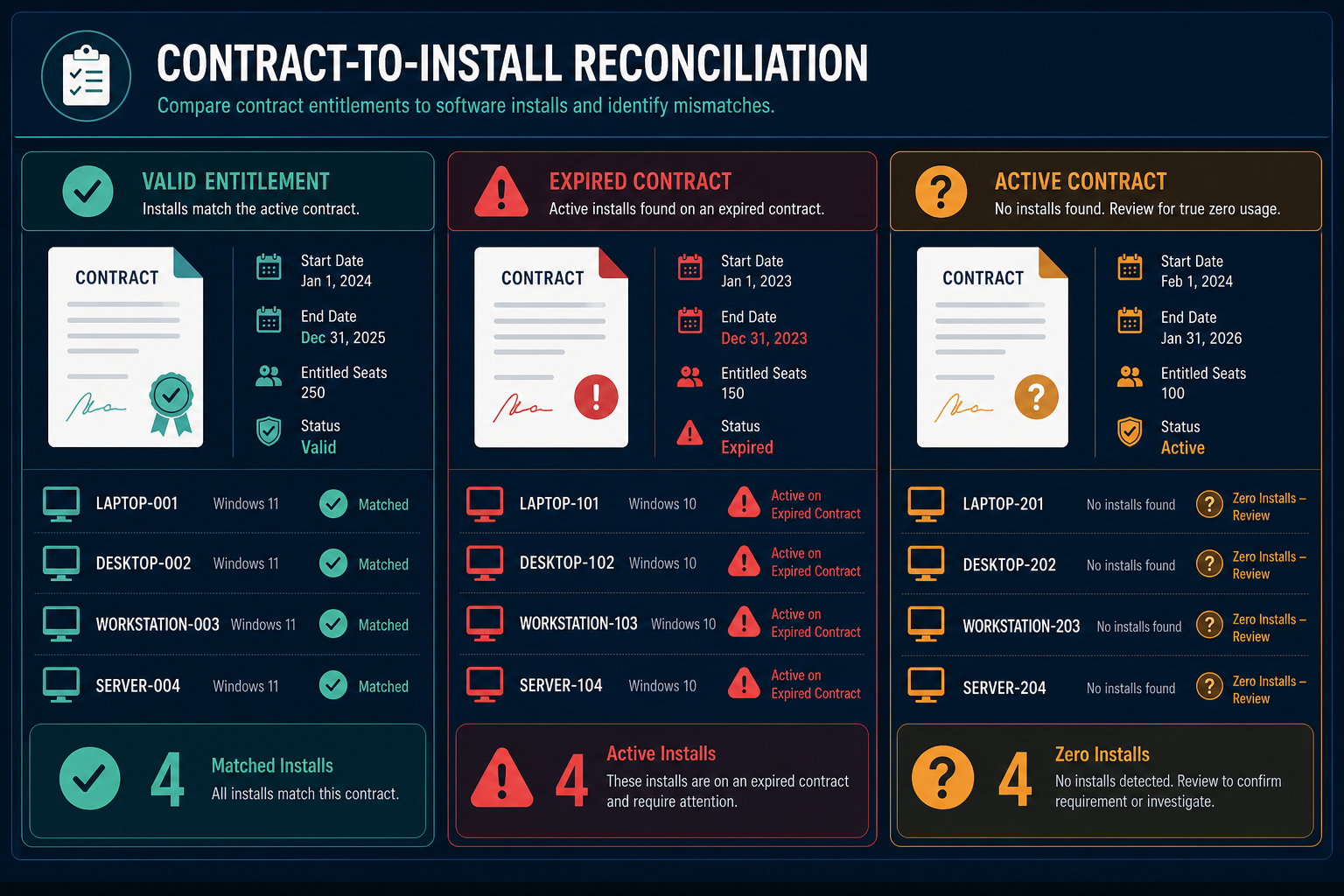
Discovery-to-entitlement reconciliation surfaces three risk states automatically: expiring contracts with active installs requiring pre-renewal action, expired contracts with active installs creating immediate compliance exposure, and cancelled contracts with active installs requiring deprovisioning. Without this reconciliation, all three states remain invisible until the vendor initiates contact.
The information needed to catch these 23 contracts before they lapsed or auto-renewed was already in our environment. We had not connected it.
For each of the 4 expired contracts where software was still running on devices, a straightforward discovery-to-entitlement reconciliation would have shown: contract expiration date passed, active installations detected. That is a Trusted Runtime Truth conflict: the entitlement record says no, the network says yes. It should trigger an immediate alert.
For the 16 auto-renewals, an active install count matched against an upcoming contract expiration date would have produced a usage report before the auto-renewal window closed. That report would have given procurement the data to negotiate from actual usage rather than assumed usage, and to decide whether to reduce the seat count or explore a different licensing tier.
For the 3 cancelled contracts, a discovery scan post-cancellation would have surfaced the 78 active installations within the first scheduled scan cycle.
The Trusted Runtime Truth model treats any gap between discovery-sourced install data and entitlement records as an actionable signal — in both directions. Over-licensed positions surface when entitlements exist but no installations are found. Under-entitlement positions surface when installations exist but no current contract covers them.
Virima’s IT asset management module surfaces both signals automatically. If you’re evaluating how to connect procurement contract data to discovery-sourced install counts, virima.com/trusted-runtime-truth covers the underlying model.
Building the connection between contracts and discovery
After the audit, we redesigned the contract-to-ITAM integration. Effective IT contract management requires contract data and asset data to live in the same system — here is what that looks like in practice.
Contract records imported into ITAM
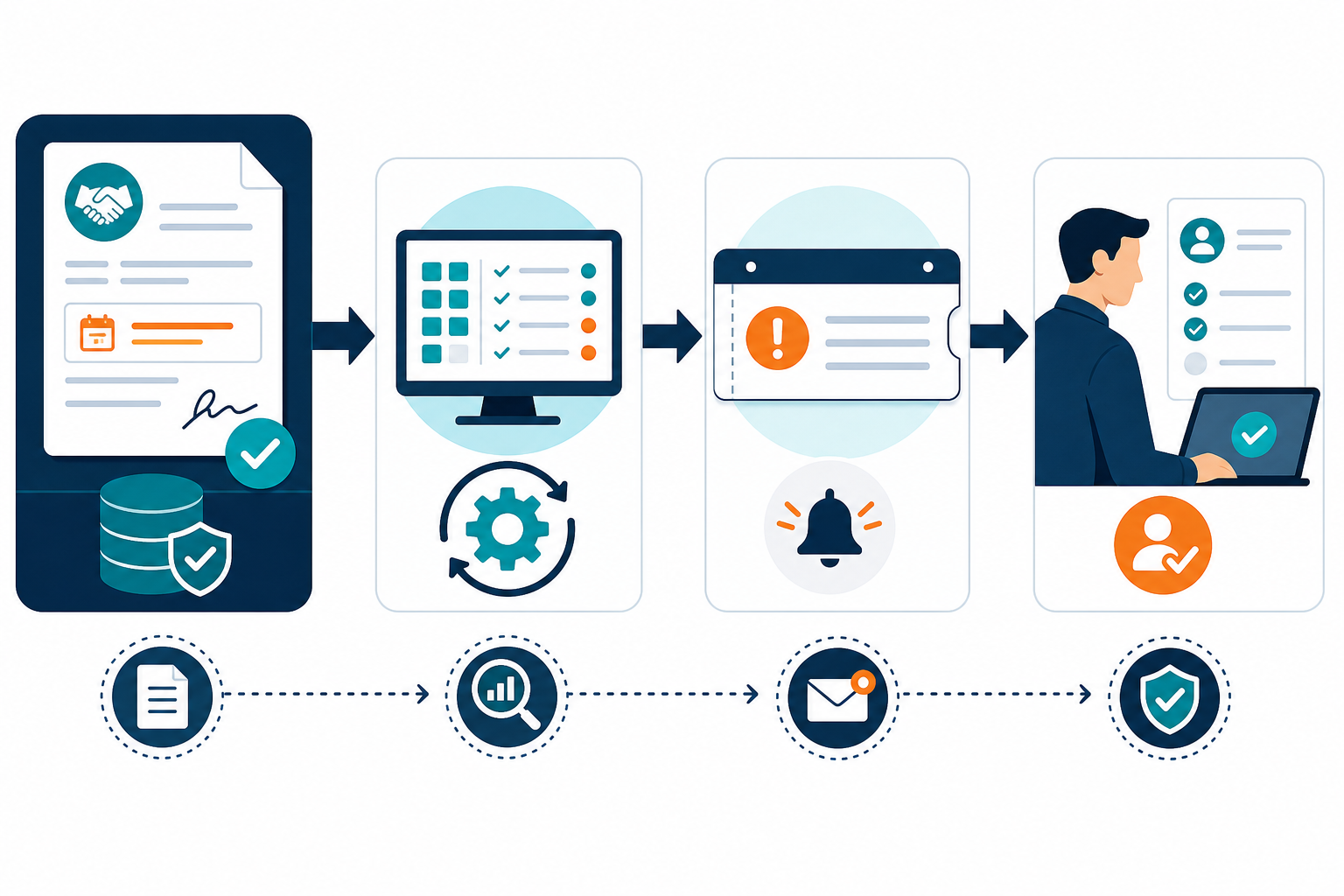
Every vendor contract now has a corresponding record in ITAM with the contract start date, end date, auto-renewal notice window, seat count, and entitlement scope. Vendor contract expiration tracking in ITAM means procurement maintains the contract record while IT maintains the install count that sits alongside it — both teams work from one shared view.
Discovery-to-entitlement reconciliation on a monthly schedule
The reconciliation compares active install counts from discovery against the entitlement record’s current seat count and validity window. Titles where the contract expiration date falls within 90 days and active installs are above zero appear on a joint IT-procurement review report.
Auto-renewal notice window integrated with ITSM
When a contract’s auto-renewal notice window opens, a ticket fires in ServiceNow assigned jointly to the procurement lead and the IT asset manager. The ticket includes the current discovery-verified install count and a usage trend from the past 12 months. Procurement cannot close the renewal decision without the IT asset manager’s sign-off on the usage data.
The first renewal cycle under the new process identified 6 contracts where actual usage was more than 30% below the licensed seat count. We renegotiated 4 of those at reduced seat tiers, saving $47,000 against what the auto-renewal list prices would have cost.
What contract-to-ITAM integration requires
Before evaluating ITAM solutions for contract management, IT asset managers should confirm the platform supports five specific capabilities:
- Contract record storage alongside discovery data — entitlement fields (start date, end date, auto-renewal window, seat count, licensing metric) stored in the same system as active install counts
- Scheduled discovery-to-entitlement reconciliation — automated comparison runs on a defined cadence, not manually triggered
- Expiration and auto-renewal window alerting — proactive notification when a contract enters its notice window, tied to current usage data
- ITSM ticket integration for renewal decisions — workflow that routes renewal sign-off to the IT asset manager with discovery-verified usage data attached
- Three-state license position reporting — over-licensed (entitlement exists, no installs), compliant, and under-entitlement (installs exceed or outlast the validity period)
Any platform that cannot support all five leaves one of the three failure modes — auto-renewed at list price, expired-but-active, or cancelled-without-deprovisioning — invisible to IT until the vendor raises it first.
Quick answers: vendor contract expiration and ITAM
Why do vendor contracts expire without IT knowing?
Vendor contracts expire without IT involvement when contract data lives in procurement systems or spreadsheets that are not connected to ITAM. Renewal reminders go to procurement and budget owners, not IT. Without discovery-sourced install counts linked to contract expiration dates, IT has no trigger to review active installations against current entitlements before a contract lapses or auto-renews.
What is the risk of software running on expired entitlements?
Software running on expired entitlements creates compliance exposure that cannot be resolved retroactively. Most enterprise software agreements include audit rights clauses allowing back-fee calculations from the contract expiration date through the audit date. Vendors control settlement terms; organizations cannot cure the gap period after the fact.
How can IT and procurement align on contract renewals?
Effective contract renewal alignment requires IT asset managers to have access to contract expiration dates and auto-renewal windows, with discovery-verified usage data available before the renewal decision. When contract records live in ITAM alongside install counts, procurement can make renewal decisions with accurate usage data rather than assumed seat requirements, reducing both over-licensing and compliance gaps.
What role does IT discovery play in contract management?
IT discovery provides the installation count that should anchor every contract renewal decision. When discovery data is matched against contract entitlements on a regular schedule, teams can see which products are over-licensed, which are approaching expiration with active installs, and which have been cancelled without proper deprovisioning. Discovery turns contract management from a spreadsheet exercise into a data-backed decision process. How Virima’s automated IT asset management boosts your ITAM processes
Closing the contract-to-ITAM gap
The 23 contracts that expired or auto-renewed without IT involvement were not a procurement failure. The procurement team did their job. The failure was systemic — the two systems simply never talked to each other.
For IT asset managers and procurement teams looking to align on software lifecycle management, the starting point for vendor contract visibility is connecting contract expiration dates to discovery-sourced install counts in a shared ITAM view. The active vs passive IT asset discovery approach matters here, because you need discovery data that reflects what is actually installed, not what was last manually recorded.
See how Virima connects contract expiration dates to discovery-sourced install counts before your next renewal window closes — request a contract management walkthrough at virima.com/request-demo.
Frequently Asked Questions
What is an auto-renewal clause in a software contract and why does it matter for IT?
Auto-renewal clauses in enterprise software contracts extend agreements at prevailing list prices if the customer misses a cancellation window, typically 30–90 days before expiration. Without discovery-verified usage data at the point of renewal, organizations forfeit the chance to renegotiate seat counts or identify over-licensed positions — renewing at full cost for capacity they do not need.
An auto-renewal clause allows a contract to renew automatically for another term, typically 12 months, if the vendor does not receive a cancellation notice within a specified window before expiration (commonly 30–90 days). Auto-renewal means the contract and its pricing continue without renegotiation. For IT teams that do not track auto-renewal notice windows tied to active usage data, contracts renew at prevailing prices without any opportunity to adjust seat counts, renegotiate terms, or evaluate alternatives.
How should IT teams handle software products that are cancelled by procurement without notification?
When procurement cancels a software contract without notifying IT, active installations remain on devices with no current entitlement. Discovery scans will surface those installs as unentitled within the next scan cycle. The immediate response should be: verify the cancellation, notify affected users, and initiate deprovisioning. Organizations that track contract terminations in ITAM with a discovery-verification step can complete this process in days rather than discovering it months later.
What contract data should live in ITAM alongside discovery data?
The minimum contract data for effective license compliance includes: contract start and end dates, auto-renewal notice window, seat count, licensing metric (per user, per device, per core), and the software title’s canonical publisher and product name. ITAM entitlement expiration tracking requires knowing when each entitlement’s validity period ends — not just when the contract document was signed. With these fields in ITAM, a scheduled reconciliation job produces a valid-entitlement-versus-active-install comparison for every title automatically.
What happens during a vendor audit for expired software licenses?
When a vendor initiates a software audit, they request installation records and license purchase documentation covering the audit period. If installations exceed current entitlements — or if software was running during a period when no valid entitlement was in place — the vendor calculates back-fees based on unlicensed instances at standard pricing for the gap period. Organizations cannot cure the gap retroactively; the only resolution is a financial settlement. Most enterprise agreements include audit rights clauses giving the vendor access at 30 days’ notice, with lookback periods that can cover the full contract term. An accurate, discovery-verified ITAM record is the only defense: it documents what was installed, when, and whether a valid entitlement existed at the time. Virima earns “Vendor to Watch” for IT Asset Inventory and Service Management
Does Virima alert IT teams before a software contract auto-renews?
Yes. When a contract record is stored in Virima’s IT asset management module with an auto-renewal notice window, the platform triggers an ITSM ticket through the ServiceNow integration when that window opens. The ticket includes the current discovery-verified install count and usage trend data, giving the IT asset manager and procurement lead the information they need before the auto-renewal deadline closes. Procurement cannot mark the renewal decision complete without the IT asset manager’s sign-off on usage data. Virima ITAM features — contract and entitlement tracking
How does Virima handle software discovered running after a contract cancellation?
When Virima’s discovery runs and finds active installations of a software title whose contract record has been marked as cancelled in the ITAM module, the reconciliation surfaces an under-entitlement flag: active installs found, no current entitlement. This triggers a review in the ITAM console, allowing the IT asset manager to verify the cancellation, initiate deprovisioning workflows, and notify affected users. Organizations that track contract terminations in ITAM alongside scheduled discovery complete this process within the next scan cycle — rather than discovering the gap months later at a vendor audit. Virima ITAM features — contract and entitlement tracking
How does Virima connect contract expiration dates with active install counts?
Virima’s IT asset management module stores contract entitlement records alongside discovery-sourced installation data. When contract expiration dates approach, scheduled discovery scans produce current install counts that surface in the same view as the entitlement record. IT asset managers and procurement teams can see which titles have active installs against expiring contracts before the renewal window closes.
What is the difference between a software contract and a software license entitlement in ITAM?
A software contract is the legal agreement with the vendor covering pricing, terms, audit rights, and renewal conditions. A software license entitlement is the specific permission to install and run software that the contract grants, typically defined by seat count, licensing metric, and validity period. Both need to live in ITAM alongside discovery data. The contract drives renewal management; the entitlement drives compliance management.