The Firewall Rule That Was ‘Low-Risk’ Until It Took Down 7 Business Services

The change ticket was six lines long. One CI. One affected network segment. Zero downstream services. Management pre-approved it as a standard change (no CAB review required, estimated at fifteen minutes of work).
By 9:47 AM, seven business services were unreachable.
This is what happens when a blast radius firewall change assessment is built on incomplete CI relationship data. The process works. The data does not.
Blast radius in a firewall change is the full set of business services, applications, and dependent systems that would be disrupted if the change produces unintended behavior. Accurate blast radius assessment requires complete CI relationship data in the CMDB — documented dependency links between configuration items, such as a firewall CI connected to the services routing through it. When those relationships are incomplete — missing services added after the last infrastructure refresh — the impact estimate returns a confident wrong answer and standard-change approvals proceed on a false risk classification.
What the change ticket said
The standard change classification process
The request was straightforward: modify an outbound ACL on a perimeter firewall to restrict specific port ranges under a security hardening directive. The CI record showed two upstream nodes (a core switch and a distribution layer device). No downstream services. No dependency chain. No blast radius beyond “network segment.”
The team pre-approved the change as standard under ITIL change management policy. The CAB never reviewed it. The engineer applied the ACL modification during the scheduled window, validated it from the firewall’s management interface, and closed the ticket.
Nothing in the process was wrong. The process ran exactly as designed.
How a firewall becomes a hidden dependency anchor
The gap between what was documented and what existed
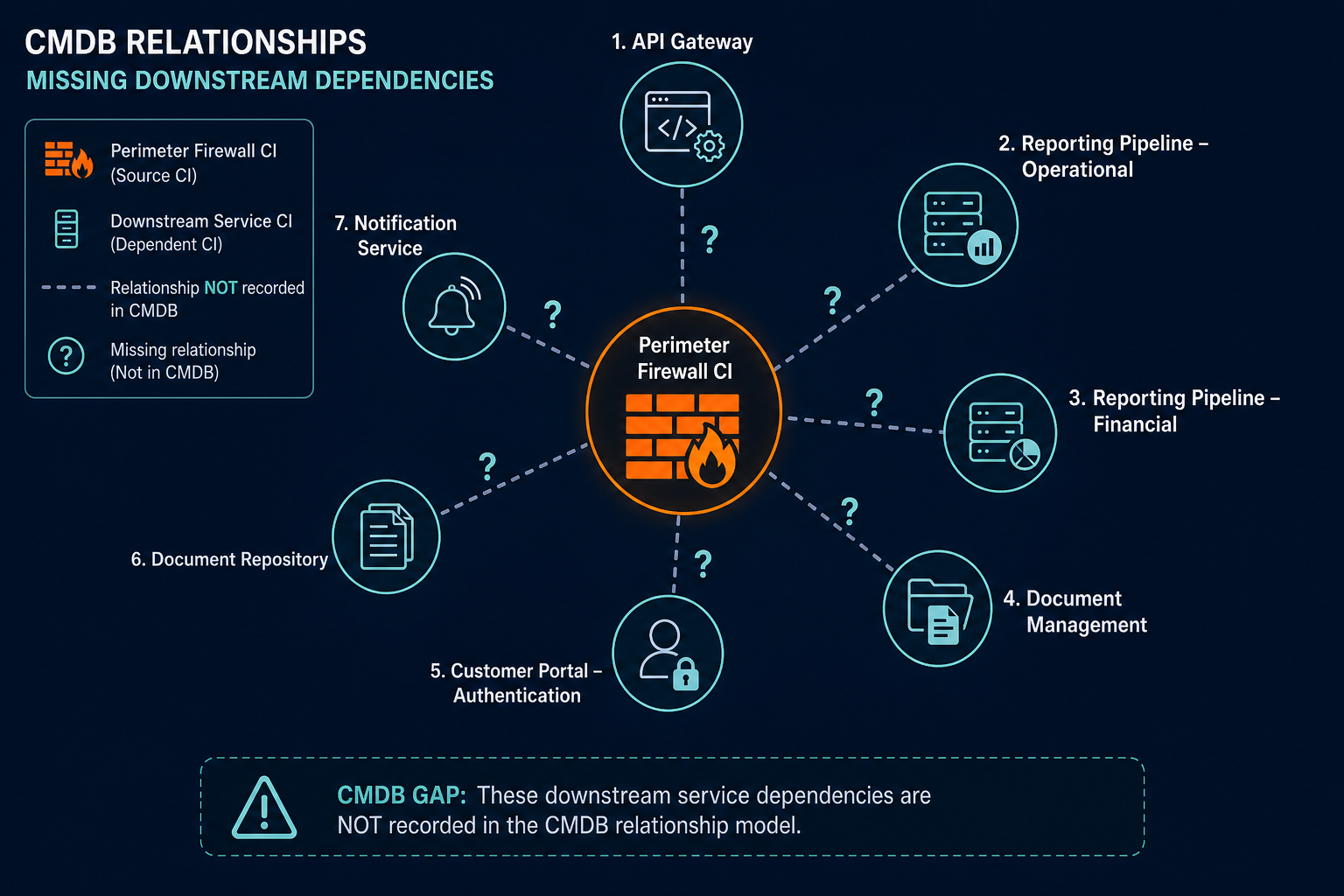
The firewall CI had existed in the CMDB for four years. Its relationship record was last updated during an infrastructure refresh in year two. In the two years since, application teams had quietly routed seven services through that perimeter segment: three SaaS API integrations, two internal reporting pipelines, a document management service, and a customer portal authentication endpoint.
None of those routing decisions generated a CI relationship update in the CMDB.
This is how CI drift accumulates in practice. Not through negligence, but through the ordinary pace of IT operations. Application teams make routing decisions. Vendors extend integrations. Migration projects land new services on existing segments. The CMDB does not update when traffic paths change. It updates when someone remembers to update it.
As first-scan results consistently show, high-frequency discovery cycles surface infrastructure realities that static documentation misses, including services that have been routing through critical CIs for months without anyone recording the dependency.
The seven services that went dark
The timeline of a cascade
At 9:24 AM, the engineer pushed the ACL change. At 9:47 AM, the first P2 alert fired. By 10:15 AM, the NOC had seven open incidents:
- Customer portal — authentication endpoint calling through the modified ACL range
- ERP reporting pipeline — external data feed blocked at the new ACL boundary
- Third-party HR SaaS integration — outbound API calls on the restricted port range
- Document management system — API calls routing through the affected segment
- Backup replication job — offsite replication path crossing the modified ACL
- Internal analytics dashboard — external data pull on the now-restricted port
- Payment gateway callback — webhook receiver on the blocked outbound range
Total time to service restoration: 3 hours 40 minutes. Root cause identification took 90 minutes because nothing in the CMDB connected the firewall change to any of these services.
Wondering what’s routing through your firewall CIs right now? See how ViVID™ surfaces hidden service dependencies. ViVID service mapping product page
What is blast radius in IT change management? Blast radius in IT change management is the set of services, applications, and CIs that would be disrupted if a change fails or causes unintended behavior. Accurate blast radius firewall change assessment requires complete CI relationship data in the CMDB. Without it, the impact scope of any change is invisible until services go down.
Why the blast radius firewall change estimate was wrong
When good process meets bad data
The engineer’s blast radius firewall change assessment wasn’t careless. It was bounded by what the CMDB actually contained. When you query a firewall CI’s relationship record and get back two upstream nodes and zero services, you write “no downstream impact” — because that is what the data says.
Standard change classification logic is sound. According to Gartner (2024), 80% of unplanned outages originate from planned changes — not because change management frameworks are broken, but because the data feeding the risk assessment is incomplete. The ITIL 4 change enablement practice is explicit that changes are classified based on risk and impact assessment. That assessment is only as accurate as the underlying configuration data. A firewall carrying authentication, reporting, payment, and document service dependencies does not belong in the standard change category. The CMDB said it was a standalone perimeter device.
The Cloudflare November 2025 outage demonstrated the same pattern at a different scale: a routing configuration change with a defined target scope produced downstream effects across services that weren’t in the original impact estimate. The scope of the change was correct. The scope of the infrastructure it touched was larger than documented.
The CISA Enhanced Visibility and Hardening Guidance for communications infrastructure (December 2024) flags the risk of firewall modifications made outside the change management process. The inverse risk is equally real: modifications made inside the process, against incomplete CI data, with confidently wrong blast radius estimates.
Why do firewall changes cause unexpected service outages? Firewall changes cause unexpected outages when the CMDB does not capture all services routing through the affected segment. If CI relationships are incomplete, the blast radius estimate reflects only documented dependencies. Services added after the last CMDB update, or by teams that never recorded the relationship, become invisible to the change impact analysis.
How CMDB dependency mapping changes the blast radius estimate
From relationship graph to change classification
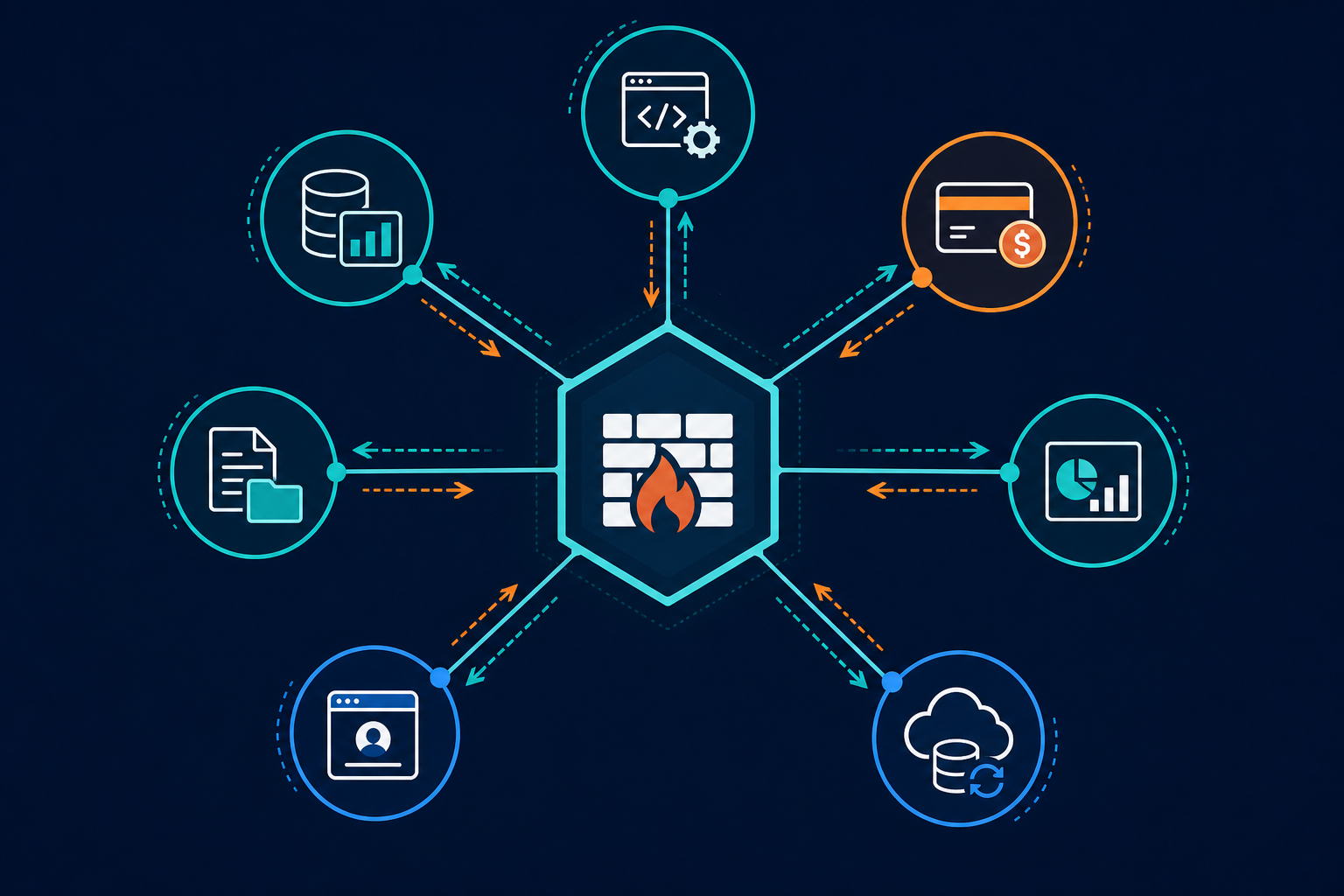
ViVID™ service maps build the service dependency blast radius picture from what discovery finds, not from what engineers documented at the last infrastructure refresh. Before a change request reaches the approval stage, a dependency query against the firewall CI would have returned the full relationship graph: seven service contexts actively routing through that perimeter segment.
That result changes the blast radius firewall change classification entirely. A firewall serving as an anchor for seven business services (including a payment callback and an authentication endpoint) does not receive a standard-change designation. It triggers a normal or emergency change review, stakeholder notification, and a pre-change validation plan.
The Trusted Runtime Truth built from discovery data is not a documentation exercise. It is the difference between a CAB approving a six-line ticket in five minutes and catching a dependency chain that would have taken four hours to unwind. See how Virima delivers Trusted Runtime Truth from live discovery data across your infrastructure.
Five CI questions to ask before approving a firewall change
Before any firewall change moves to approval, a dependency query should return answers to these five questions:
- When was the last discovery scan that touched this CI? If the answer is more than 30 days, the relationship record is suspect.
- Which services actively route traffic through this segment? Not what’s documented — what’s actually traversing the affected port ranges based on live topology.
- Have application teams confirmed the downstream dependency list? Network-layer CIs are owned by infrastructure teams whose visibility stops at the routing layer. Application owners know what’s running through the segment.
- Are any routing paths managed by external vendors? Vendor integrations rarely trigger CMDB relationship updates. API-based discovery picks them up; manual CMDB updates do not.
- If the blast radius estimate is zero services, what changes if it’s wrong? A rollback plan sized to zero impact provides no protection against undocumented services going dark.
Why ‘low-risk’ classifications fail without CI relationship data
The cost of confident wrong estimates
The standard change framework is not broken. Standard changes exist for a reason. Not every change needs full CAB scrutiny, and a mature change risk intelligence practice depends on some changes being pre-approved to maintain velocity.
The failure point is the data feeding the classification. A change management workflow built on an incomplete CMDB produces incorrect risk scores for every CI whose relationship record has not been updated since the last infrastructure refresh.
The blast radius firewall change estimate in this scenario wasn’t a guess. It was a structured assessment that returned a precise wrong answer: zero services affected. That false precision is more dangerous than an acknowledged data gap. It triggers approvals that a “data unknown” label would not.
How does CMDB data quality affect change risk classification? Change risk classifications in ITSM tools draw from CI relationship records. Incomplete relationships produce underestimated blast radius scores, pushing changes into lower-risk categories than the actual infrastructure warrants. Virima’s discovery engine runs agentless, agent-based, and API-based scans in parallel, updating CI relationships across hybrid environments automatically — keeping risk scores tied to what the infrastructure actually looks like, not what was documented months ago.
The post-incident finding
What four years of manual updates failed to capture
After the outage, the team ran a retroactive dependency trace. The seven services had been routing through that firewall segment for between 3 and 22 months. Three of the dependencies were added by external vendors. Two were created during a migration project that predated the current CMDB owner.
Manual CMDB updates failed to capture all of them. The pattern is consistent across post-incident reviews:
- Routing changes made by application teams who don’t own the CMDB
- Dependencies added by external vendors during integration work
- Services added to existing segments during migration projects
- ACL scope expansions that shifted traffic paths without triggering CI record updates
The post-incident action item wasn’t “remind teams to update the CMDB.” It was: stop depending on manual updates and build CI relationships from what discovery finds.
The CMDB dependency gap that produced this outage is not unusual. It is the default state of any CMDB that relies on human-initiated relationship updates. Discovery-driven CI relationship maintenance closes that gap without requiring teams to change how they work. Every scan produces an updated relationship graph. Every change impact query draws from that graph, not from a record last touched eighteen months ago.
A correct blast radius firewall change assessment requires CI relationships that reflect the infrastructure as it actually exists, not as it was documented when the CMDB was last maintained.
When the process is right but the data is wrong
Standard change frameworks, CAB reviews, and blast radius assessments all work correctly when the underlying CI data is accurate. The failure in this scenario wasn’t at the process level. It was a data quality problem that the process had no way to detect.
Seven services went down because a firewall CI’s relationship record was years out of date and nobody knew it. The blast radius firewall change classification returned “standard” because the CMDB said it was standard. The CMDB was wrong.
According to Uptime Institute (2025), 54% of enterprise outages cost more than $100,000 in direct business impact — and 20% exceed $1 million. A 3-hour, 40-minute outage affecting a payment gateway callback and customer portal authentication endpoint falls comfortably inside that range. The cost was not a process failure. It was the cost of a CI relationship record that hadn’t been updated in two years.
Trusted Runtime Truth built from discovery data does not eliminate change risk. It eliminates the category of risk that comes from not knowing what depends on what — which in this scenario was the only risk that mattered.