The Undocumented Payment Service Dependency That Took Payment Processing Offline

An undocumented payment service dependency is a component that payment processing actively calls in production but is absent from its CMDB service record. These dependencies typically originate from informal integrations added during payment gateway migrations and never formally documented. When change impact analysis runs against a CMDB that omits them, the blast radius excludes payment processing — and approved maintenance windows can take it offline.
The maintenance window had change advisory board approval. The middleware server scheduled for a four-hour patching window was classified as a non-critical shared services component. The change impact analysis returned zero affected business services. The CAB approved. The window started at 10:00 PM on a Thursday. By 10:07 PM, the payment processing service was offline. The CMDB, every service definition, and the change impact assessment contained no record of the payment processing service’s dependency on the middleware server. This is a post-mortem of what was missing in the CMDB, and what discovery-built service maps would have surfaced before the window started.
The change that looked routine
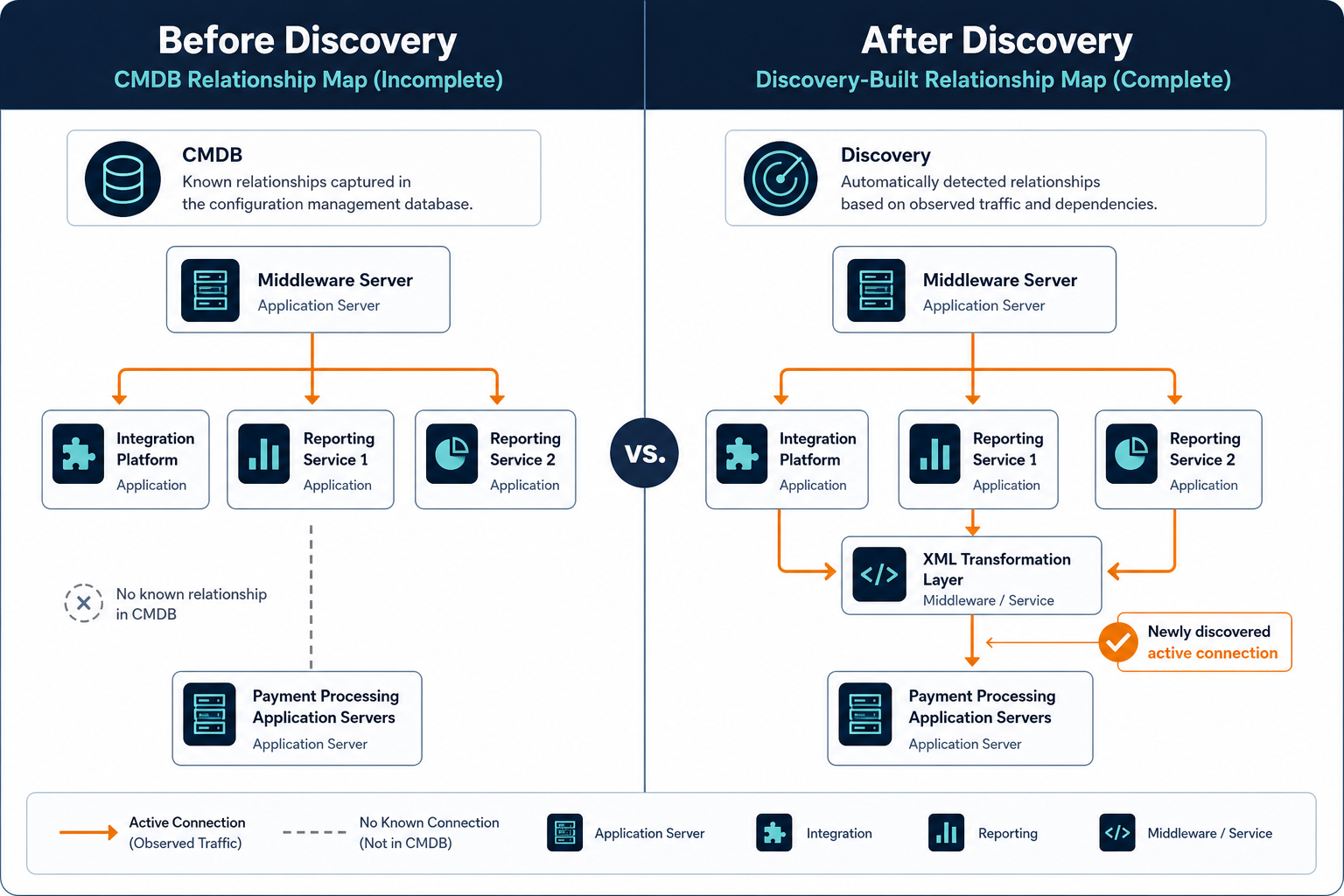
The middleware server in question hosted an XML transformation layer used by the enterprise integration platform. The integration platform itself was in scope for the change impact analysis. The payment processing service was not. The payment processing service definition listed the payment gateway, the transaction processing servers, the payment database, and the fraud detection API. It did not list the XML transformation layer hosted on the middleware server.
For organizations processing payment transactions around the clock, even a brief service interruption during a maintenance window can trigger SLA penalties, PCI-DSS incident notification requirements, and direct revenue exposure. Gartner estimates enterprise payment downtime at $15,000 to $100,000 per minute in lost transaction volume — a figure that transforms an approved, routine patching window into a board-level risk event when a dependency gap goes undiscovered.
The undocumented payment service dependency existed because the payment processing service used the XML transformation layer to format transaction data for the payment gateway API. The dependency had been introduced during a payment gateway migration 18 months earlier, when a developer added an integration call to the transformation layer as a quick solution to a format compatibility problem. The call was never formally documented in the service definition. The middleware server became a dependency of the payment processing service without any CI relationship — a configuration item dependency record — being created in the CMDB.
When ViVID™ service maps built from IT discovery data would have shown the relationship: an active connection from the payment processing application servers to the XML transformation service on the middleware server. The connection ran on every transaction. It had been running for 18 months.
What the CMDB showed before the window
The CMDB record for the middleware server listed it as a dependency of the enterprise integration platform and two internal reporting services. The payment processing service CMDB record listed its own documented dependencies with no reference to the middleware server. The change impact analysis tool queried the CMDB for all services with a recorded dependency on the middleware server and found three: the integration platform and the two reporting services. The payment processing service was not in the result set.
The CAB reviewed the change with that information. Three services affected, all non-customer-facing during the maintenance window hours. Approved. The payment processing service, which processes customer transactions around the clock, was invisible in the blast radius because the undocumented payment service dependency was absent from the CMDB best practices data that the change process ran against.
Why undocumented payment service dependencies form
Payment processing services accumulate undocumented dependencies through the same mechanisms that create undocumented dependencies in any complex service, but with higher consequence because payment processing availability directly affects revenue and regulatory compliance.
Developer-level integrations are the most common source. When a developer adds a call to a shared transformation service to solve a format compatibility problem during a migration, the fix is immediate. The service definition update almost never is. The developer who added the call may not know that service definitions exist, or may intend to formalize the integration later and never do so.
Migration-era integrations age invisibly. A dependency introduced during a payment gateway migration becomes embedded in the payment processing service architecture. Team membership changes. The developer who added the integration call leaves. The documentation of the informal integration call is the institutional memory of one person, and it leaves with them.
This class of undocumented middleware dependency is exactly the CMDB gap that team-owned service definitions leave uncovered. When payment processing communicates through an enterprise integration platform, the individual transformation services the platform calls may not appear in any service definition for the payment processing service. The payment team documents the integration platform. Nobody documents the end-to-end dependency from payment processing to transformation service.
The documentation patterns that create CMDB gaps
Service definitions describe what teams know they own. The XML transformation layer on the middleware server belonged to the integration platform team. The payment processing team did not own it, did not manage it, and did not list it in their service definition. From the payment processing team’s perspective, they used the integration platform. The integration platform’s internal components were not their documentation responsibility.
This team-ownership-based documentation model produces CMDB gaps at every shared component that crosses team boundaries. The EMA ServiceOps 2025 report identifies cross-team shared component dependencies as the category of undocumented dependency most commonly implicated in service outages during planned maintenance windows.
What discovery would have surfaced before the window
Virima’s IT discovery running against the environment before the maintenance window would have found the active connection from the payment processing application servers to the XML transformation service on the middleware server. Discovery does not consult team-authored service definitions. It reads the network: which processes on which servers are connecting to which other servers, on which ports, and with what frequency.
The payment processing application servers were making calls to the middleware server on port 443 approximately 850 times per minute during peak transaction periods. Discovery maps that connection as a CI relationship: payment processing application server to middleware XML transformation service. When ViVID™ builds the service map from that relationship data, the middleware server appears in the payment processing service map as a dependency alongside the payment gateway and the transaction database.
The change impact analysis running against the discovery-built service map would have returned four affected services for the middleware maintenance window: the integration platform, the two reporting services, and the payment processing service. The CAB would have reviewed a change affecting a payment processing service during a window covering late-night transaction processing. The approval decision would have been different. The window timing would have been different. The payment service outage CMDB gap that produced the 10:07 PM incident would not have existed.
What ViVID™ maps for payment processing environments
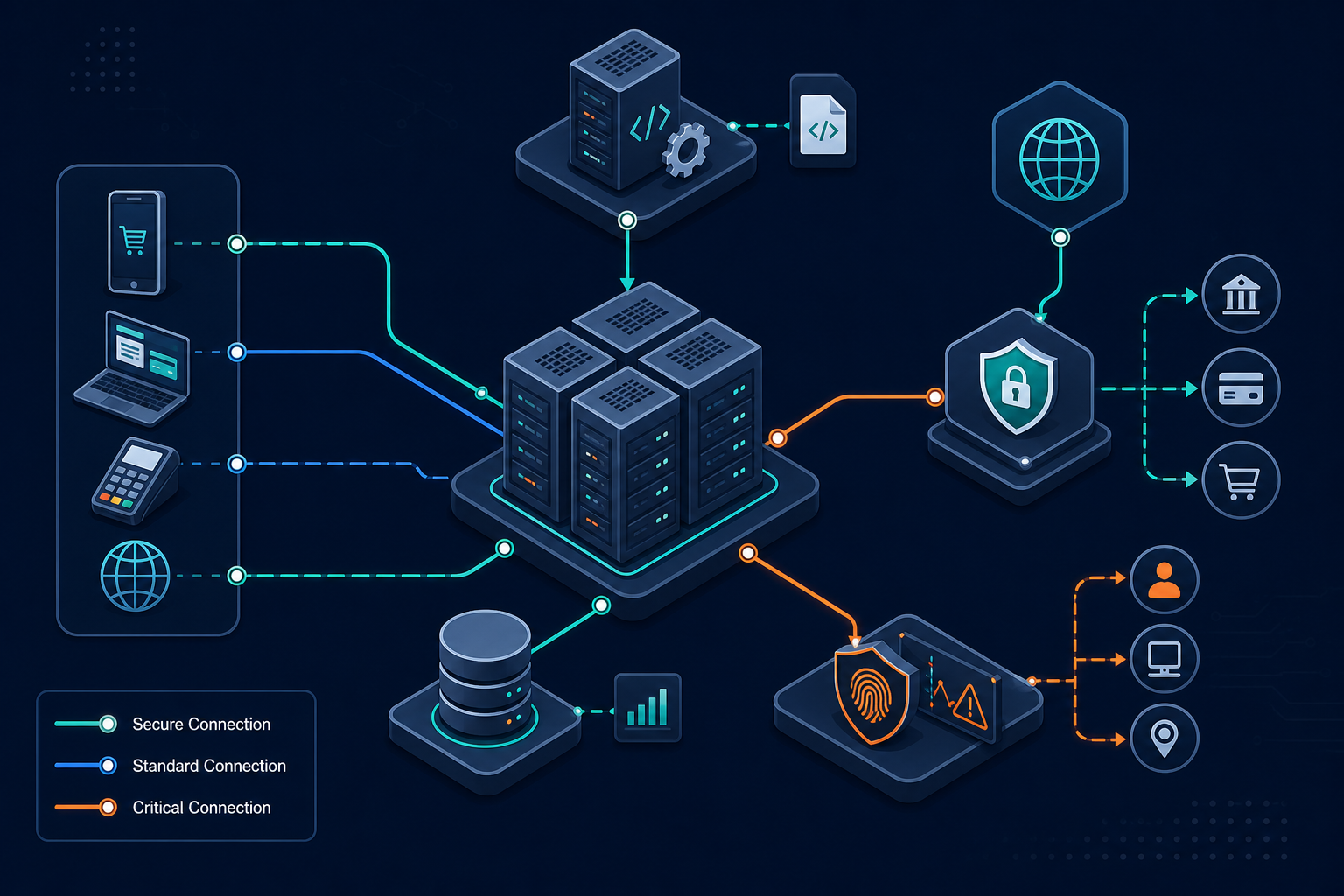
ViVID™ service maps for payment processing environments map the complete dependency chain from the payment processing application servers through every integration layer to the payment gateway and the transaction database. The map extends to fraud detection services and any shared infrastructure components that payment processing communicates with. The map is built from discovery-sourced relationship data, not from team-authored service definitions.
This means the XML transformation layer, the load balancer handling payment API traffic, the authentication service validating transaction tokens, and any other component with an active connection to the payment processing service appear in the map. None of them need to appear in any team’s service definition to be included.
After the outage: what the post-mortem found
Post-incident reviews for payment service outages during planned maintenance windows almost always return the same root cause: a CI relationship absent from the CMDB that was present in production. The fix applied after the incident is almost always a manual CMDB update: adding the undocumented dependency to the payment service CI record so that future change impact analyses will include it.
The business cost of that seven-minute gap is concrete. Gartner estimates enterprise payment downtime at $15,000 to $100,000 per minute in lost transaction volume — before SLA penalties or regulatory notification costs. The Uptime Institute’s Annual Outage Analysis finds 64% of significant IT outages stem from change or configuration failures, making undocumented dependency gaps the most preventable category of planned-maintenance risk.
The problem with the manual update approach is that it only captures the dependencies found during the post-incident investigation. It does not address whether other undocumented payment service dependencies exist that have not yet caused an incident. According to the EMA ServiceOps report, teams that rely on post-incident CMDB corrections face recurring incidents at the same hidden dependencies within 6–18 months. Staff turnover or technology changes are sufficient to mask the single source of institutional knowledge that kept the dependency visible.
The structural fix is to run IT discovery against the payment processing environment and build service maps from the resulting relationship data. Discovery finds all active connections, not just the ones that failed during the last incident. Connecting those discovery-sourced maps to ServiceNow change management workflows means every future change impact analysis includes the payment service dependencies that are actually running.
Explore how ViVID™ builds discovery-sourced ground truth for payment processing environments at virima.com/trusted-runtime-truth/.
The blast radius calculation that should have run
The blast radius calculation for the middleware maintenance window should have included the payment processing service as an affected party. It did not because the CMDB did not record the dependency. The change impact analysis tool was not at fault. The CAB process was not at fault. The documentation model that left an active payment processing dependency outside the scope of the payment service definition was the root cause.
Blast radius calculations based on Trusted Runtime Truth include every component with a live relationship to the CI under change. Discovery-sourced service mapping provides that truth. The alternative — managing blast radius accuracy through post-incident CMDB updates — means every undocumented dependency is discovered at the cost of an outage. Schedule a demo to see how Virima surfaces payment service dependencies before the next maintenance window.
Frequently Asked Questions
What is an undocumented payment service dependency?
An undocumented payment service dependency is a component that the payment processing service actively uses but that is not recorded in the CMDB as a dependency of that service. These typically arise from informal integrations added during payment gateway migrations, incident fixes, or format compatibility patches that were never formally captured in service definitions or CMDB relationship records.
Why do payment service outages occur during planned maintenance windows?
Payment service outages during planned maintenance windows occur when change impact analysis does not identify the payment processing service as affected by the change. This happens when a component that payment processing depends on is not recorded in the CMDB as a dependency of the payment service. The CAB approves the change based on an incomplete blast radius assessment that excludes the payment service from the affected services list.
How does IT discovery find undocumented payment service dependencies?
IT discovery maps active network connections from payment processing application servers to every component they communicate with, using network traffic analysis and process dependency tracing. When discovery finds a connection from a payment processing server to a middleware or transformation component not listed in the payment service definition, it creates a CI relationship record that appears in the service map and the change impact analysis.
What information does a payment service CMDB record need to prevent outages during maintenance?
A payment service CMDB record needs to include every component that the payment processing service communicates with in production, including shared transformation services, integration platform components, authentication services, and any middleware layers used for format conversion or protocol translation. Service definitions that list only the components a single team manages miss cross-team shared dependencies that represent the highest-risk CMDB gaps.
How does ViVID™ service mapping prevent payment service outage CMDB gaps?
ViVID™ builds service maps from discovery-sourced relationship data rather than team-authored service definitions. When Virima’s IT discovery maps an active connection from a payment processing server to any component, the connection appears in the ViVID™ payment processing service map. Change impact analysis against that map includes every discovered dependency, preventing maintenance window approvals that would have excluded the payment service from their blast radius.
Does Virima’s discovery work in PCI DSS-scoped payment environments?
Virima’s agentless discovery uses passive network observation rather than active scanning, making it compatible with PCI DSS-scoped payment environments. Discovery identifies payment service dependencies — including shared transformation layers and authentication services — without injecting traffic into the cardholder data environment or requiring agent installation on payment servers.