Service Mapping in Insurance, Connecting Claims Processing Dependencies for Faster Root Cause Analysis

On June 7, 2025, Erie Insurance’s security team spotted unusual activity on its network. The company disconnected systems to contain the threat. Quoting, billing, the mobile app, and claims all went dark at once because they all sat on shared infrastructure. Full business operations did not resume until July 7, a full month later. Erie described its own recovery as “intentional, phased and prioritized.” Weeks earlier, Philadelphia Insurance Companies, a Tokio Marine subsidiary, went through a comparable 22-day sequence: disconnect, investigate, and bring systems back online gradually.
Neither company has said its recovery took so long because nobody could see how one system depended on another. But the shape of both recoveries, cautious and sequential, one verified system at a time, is telling. It is what tends to happen when a claims environment has no live picture of its own dependencies, and every reconnection becomes a judgment call instead of a lookup.
That gap is the subject of this piece. It is what it costs an insurer when nobody can answer, in the middle of an incident, exactly what a failing system supports and what depends on it. It is also what changes once a live dependency map, service mapping, sits underneath claims operations instead of a diagram nobody has opened since the last audit.
What Is Service Mapping in Insurance IT?
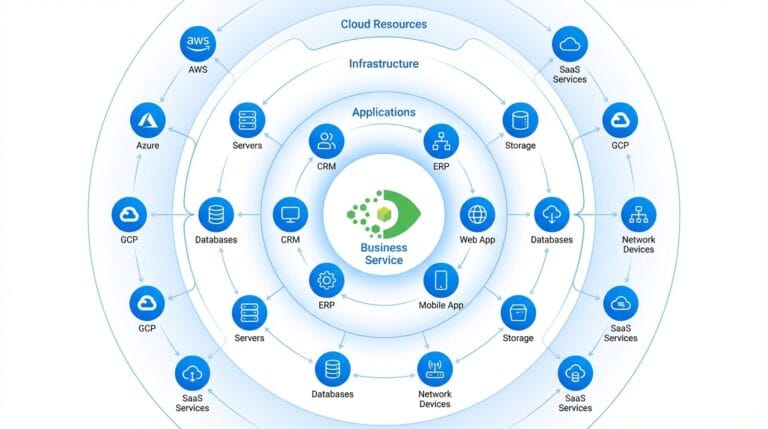
In IT service management frameworks, service mapping documents and visualizes the connections between technology components and the business services they support. Applied to insurance, it extends that idea to the claims processing chain. That chain runs through the servers, databases, APIs, and third-party integrations that carry a claim from first notice of loss through investigation, adjudication, and payment.
A claims management application does not run in isolation. It depends on a policy administration system to confirm coverage, a document management layer to store evidence, and a payment platform to issue funds. It often also depends on third-party feeds such as telematics data, repair networks, or catastrophe modeling services. Service mapping captures how these pieces connect, so the effect of a change or failure in one is visible before it becomes an outage.
What is service mapping in insurance IT?
Service mapping in insurance IT is the discovery and visualization of how infrastructure, applications, and third-party integrations connect to support claims processing. It lets IT and claims teams trace outages back to a root cause quickly, rather than reconstructing the picture from memory during an incident.
Insurance claims environments carry a specific set of demands:
- Claims Timeline Awareness: knowing which systems sit on the path to a state claims-handling deadline, so an outage does not silently put a regulatory clock at risk.
- Third-Party Dependency Visibility: tracking the API and vendor connections, telematics feeds, repair networks, and data exchanges that sit outside the carrier’s own data center but still touch active claims.
- Change Blast Radius: understanding what a rating engine patch, a database migration, or a network change will touch before it executes, not after a claim stalls.
- Audit-Ready Evidence: producing a dependency record that regulators or internal auditors can review, instead of a diagram redrawn from memory each time someone asks for one.
This kind of mapping is not unique to claims systems. It applies broadly across service-oriented businesses like banks, insurers, and hospitals, anywhere the business runs on interactions between systems and customers rather than a single monolithic application. Claims processing is simply where the stakes for an insurer concentrate most tightly.
The Hidden Problem: Claims Dependencies Nobody Mapped
Without a current dependency map, IT and claims operations teams work from static diagrams and institutional memory. That gap shows up in specific, recurring scenarios.
Why Service Mapping Matters for Claims Processing
Claims processing depends on interconnected systems: policy administration, document management, payment platforms, and third-party feeds. An unmapped outage delays claims quietly, and that delay carries real weight. Nearly every US state has adopted some version of the NAIC’s Unfair Claims Settlement Practices Act, which sets firm windows for acknowledging, investigating, and resolving a claim. Under the NAIC’s model regulation, an insurer that cannot complete an investigation on time must send the claimant a written explanation every 45 days. An IT outage that delays a claims decision does not just frustrate a policyholder. It can push the carrier toward the conduct regulators define as an unfair claims practice.
Policyholders notice long before regulators do. J.D. Power’s 2024 Claims Digital Experience Study found that customer satisfaction drops significantly when digital claims channels perform poorly or fail to communicate well. At the same time, US property and casualty combined ratios are projected to worsen from 97.2% in 2024 to 99% in 2026. Margins are tightening at the same time claims infrastructure keeps getting harder to see into.
Four Failure Modes That Start With an Unmapped Dependency
- Silent Intake Failures: A shared authentication service or API gateway degrades, and first notice of loss submissions fail without an obvious alarm. Result: claims sit unopened past the acknowledgment window before anyone notices.
- Change Collisions: Two teams schedule unrelated changes on systems that, it turns out, share infrastructure. Result: a routine patch and a routine migration collide, and the failure looks unrelated to either change until someone traces it by hand.
- Vendor Blind Spots: A claims workflow depends on a third-party integration, telematics, repair estimating, and catastrophe data that IT never formally mapped. Result: when the vendor has an outage, the carrier’s own team spends the first hour just confirming exposure.
- Regulatory Timeline Breaches: An extended outage delays claims decisions past a statutory deadline. Result: compliance leads handle regulator inquiries that an earlier change-impact check would have prevented.
The Real Cost of Flying Blind in Claims IT
For CIOs and the Board
A month-long, systemwide outage is now a documented possibility for a carrier, not a hypothetical one, as the Erie Insurance and Philadelphia Insurance Companies incidents showed. Board-level reporting increasingly has to answer not just whether operations are restored, but how confidently IT can describe what is connected to what. A live dependency map answers that question, and a static diagram does not.
For Claims and IT Operations Teams
Every minute spent reconstructing a dependency chain from memory is a minute a claim sits unresolved. Teams without a current map spend the early part of every major incident just confirming what is affected, before root cause work can even begin.
For Compliance and Regulatory Teams
Insurers licensed in New York carry a hard deadline on top of the ones claims teams already track. Under 23 NYCRR Part 500, covered entities include New York-licensed insurers. They must notify the state’s Department of Financial Services within 72 hours of determining that a qualifying cybersecurity event has occurred. Meeting that clock is difficult when the first several hours of an incident go to figuring out what broke, rather than proving it after the fact.
The Market-Scale Challenge
Financial services carried an average breach cost of $6.3 million in IBM’s 2026 breach report. High-business-impact outages in financial services now average $1.8 million per hour of downtime, according to New Relic’s 2025 forecast. Every hour a team spends tracing a dependency by hand is an hour inside that cost window.
How Service Mapping Resolves Claims Infrastructure Blind Spots
1. Discovery-Sourced CMDB Accuracy
Virima’s IT discovery runs on high-frequency scheduled scans across on-premises infrastructure, cloud accounts, and connected SaaS platforms. The CMDB it feeds reflects what is actually running, not what was documented at the last audit. Every discovered configuration item carries a source tag and a timestamp.
2. Dependency Visualization for Change and Incident Review
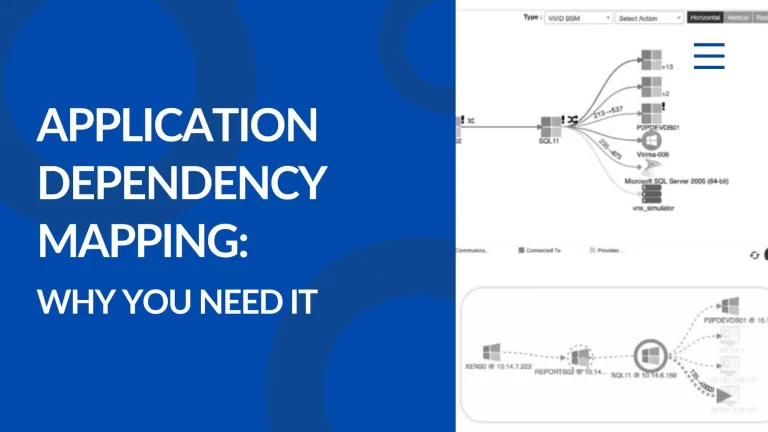
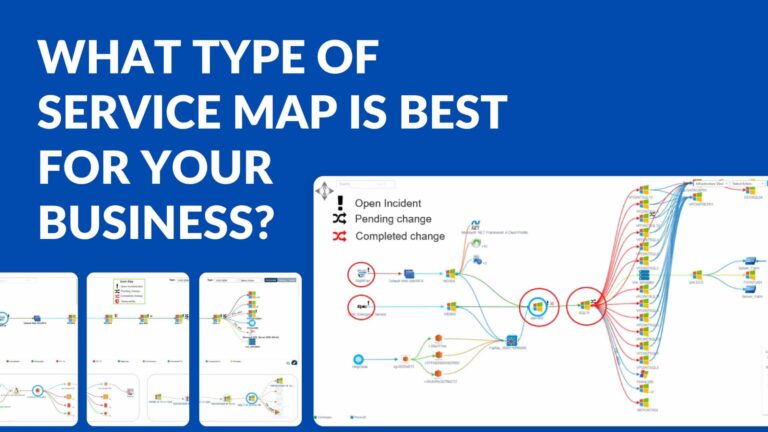
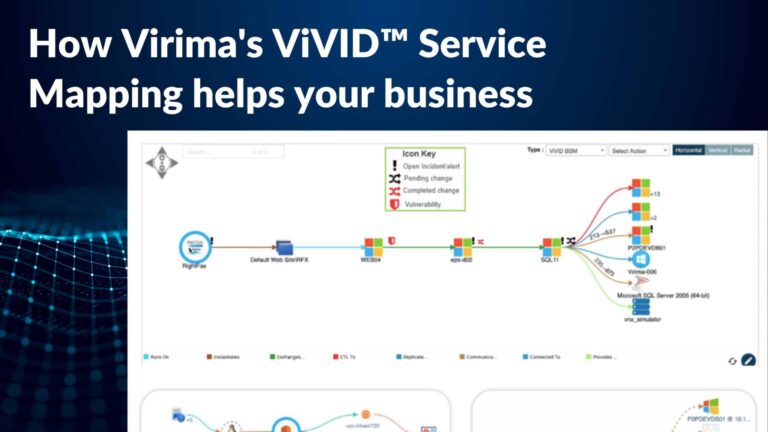
ViVID™ Service Mapping turns that discovery data into a live, navigable map. Before a change advisory board approves a rating engine patch, reviewers can see every claims workflow that touches the affected service through Virima’s change management use case. During an incident, responders use the same map to trace root cause faster, instead of querying five separate tools.
3. Cross-Platform ITSM Synchronization
Most carriers route claims and IT operations tickets through a platform like ServiceNow, Jira Service Management, or Ivanti. Virima’s bidirectional integrations with ServiceNow, Jira Service Management, and Ivanti keep configuration data consistent across every team working an incident, instead of leaving one group looking at a stale copy.
Service Mapping in Practice: Claims Scenarios
- Rating Engine Patch Review: Before approving a patch to a shared rating microservice, the change advisory board opens the service map and sees that a claims estimator reads the same service. The patch window gets coordinated with the claims team instead of colliding with it.
- Telematics Vendor Outage: When a usage-based insurance data provider goes down, the claims operations team pulls up the map. They see immediately which active claims depend on that feed, instead of checking each open claim by hand.
- Cyber Incident Recovery Sequencing: During a network containment event like the one Erie Insurance faced, a live dependency map changes recovery. IT brings systems back in an order based on documented dependencies, not judgment calls made under pressure.
- Post-Merger Consolidation: After acquiring another carrier’s book of business, IT leadership discovers and reconciles the acquired claims infrastructure into one CMDB. IT leadership then retires duplicate systems once the team confirms no active claim still depends on them.
How Virima Supports Service Mapping for Insurance Claims IT
Virima combines automated discovery, a reconciled CMDB, and ViVID’s dependency visualization into a single operational context layer for the systems underneath claims processing.
Immediate Operational Impact
When an incident hits, ViVID overlays active incidents, recent changes, and known vulnerabilities directly on the dependency map. Responders trace a failing service back to its originating configuration item instead of querying application logs, ticket history, and network diagrams as three separate steps.
Long-Term Accuracy
High-frequency scheduled discovery keeps the CMDB current as claims infrastructure changes: servers get added, cloud instances spin up, and integrations get replaced. The CMDB reconciles data from multiple sources into one record per configuration item. The map reflects the environment as it exists today, not as it existed at the last documented review.
Integration With Existing Claims and ITSM Workflows
Virima does not ask a carrier to replace its claims management system or its ITSM platform. Bidirectional synchronization with ServiceNow, Jira Service Management, Ivanti, and other ITSM platforms brings dependency context into the tools claims and IT teams already use for incident and change tickets. The same underlying visibility also supports how carriers document their own AI and infrastructure exposure for cyber insurance underwriters.
Note: Virima maps the infrastructure and service dependencies underneath claims processing. It does not adjudicate claims, determine coverage, or serve as the system of record for claims data, and it does not itself enforce state claims-handling deadlines. It operates upstream, giving IT and compliance teams the dependency evidence those decisions rely on.
Moving From Tribal Knowledge to Map-Driven Claims Operations
What Changes Once the Map Is Current
- For Claims Operations: fewer silent slowdowns, because a failing dependency shows up on a map instead of surfacing only once adjusters escalate.
- For IT and Change Management: fewer failed changes, because blast radius is visible before a change advisory board approves anything.
- For Compliance: faster answers to auditors and regulators, because the dependency record already exists instead of needing to be rebuilt under deadline pressure.
Getting Started: Five Steps
- Catalog the claims-critical systems. List every application on the path from first notice of loss to payment, including third-party integrations.
- Run discovery across the full estate. Cover on-premises infrastructure, cloud accounts, and connected SaaS platforms.
- Map high-traffic services first. Build dependency maps for the systems that touch the highest volume of active claims.
- Put the map in front of the change advisory board. Require reviewers to check the dependency map before approving patches or migrations.
- Set a discovery cadence and an owner. Define how often discovery runs and who owns CMDB reconciliation.
See Your Own Claims Dependencies Before the Next Incident Does
A rating engine patch, a vendor outage, a post-merger cleanup: every scenario in this piece burns hours on manual tracing before root cause work can even start. With a live map, that same incident becomes a lookup instead of an investigation. The difference is not more headcount or a longer change freeze. It comes down to whether your claims infrastructure has a current, discovery-sourced picture of itself. Schedule a Virima demo to see it mapped against your own claims environment.
Why is service mapping important for claims processing?
Service mapping is important for claims processing because claims workflows rely on interconnected policy, document, payment, and third-party systems. Mapping these dependencies helps IT and claims teams resolve outages faster, evaluate change risks before updates occur, and comply with state claims-handling deadlines.
Frequently Asked Questions
What is service mapping in insurance IT?
Service mapping in insurance IT is the discovery and visualization of how infrastructure, applications, and third-party integrations connect to support claims processing. It lets IT and claims teams trace outages back to a root cause quickly, rather than reconstructing the picture from memory during an incident.
Why is service mapping important for claims processing?
Claims processing depends on interconnected systems: policy administration, document management, payment platforms, and third-party feeds. An unmapped outage delays claims quietly, risking the timelines that state Unfair Claims Settlement Practices Act rules require insurers to meet.
What are examples of service mapping in insurance?
Examples include mapping which claims workflows call a telematics vendor’s API, and tracing which systems share a rating engine before a patch. It also means visualizing infrastructure inherited after an acquisition so duplicate or orphaned systems can be retired safely.
Does service mapping replace a claims management system?
No, service mapping operates upstream of claims management and policy administration systems. It discovers and visualizes the infrastructure those applications run on, giving IT and compliance teams dependency evidence, not claims decisions, coverage determinations, or payment authority.
How does service mapping help during a claims system outage?
During an outage, a live service map shows responders which configuration item failed and which claims workflows depend on it. That cuts the manual tracing that normally delays root cause work and extends how long a claims system stays down.