Shared Database Dependencies: The CMDB Trap Nobody Sees Coming

Two IT teams at the same organization owned separate service definitions. The ERP team listed the database servers hosting ERP transactional data. The customer portal team listed the database servers hosting portal sessions and product catalog data. Neither team listed a shared database cluster that processed writes for both systems. Nobody documented the shared database dependency because nobody in either team knew it existed — it reflected a configuration decision made during a legacy migration three years earlier and never formalized in any service record. A routine database maintenance window, approved through the change advisory board and classified as affecting only the ERP service, nearly took the customer portal offline simultaneously. IT discovery caught it first.
What is a shared database dependency? A shared database dependency occurs when two or more independent business services actively connect to the same database cluster or instance, but neither service’s CI record in the CMDB documents that shared connection. Because the relationship is absent from the CMDB, change impact analysis excludes affected services from blast radius calculations — turning planned maintenance windows into unplanned outages.
Two services, one database, zero documentation
The maintenance window request looked straightforward. A database cluster serving the ERP system required patching. The change requester listed the ERP service as the affected business service, identified the database cluster as the CI under change, and ran change impact analysis through the CMDB — following standard ITIL change management practice. The impact analysis returned one affected service: ERP. The CAB approved the window.
What the CMDB did not show: the same database cluster hosted a schema used by the customer portal application for product catalog queries. The portal application’s service definition listed its own database servers but made no reference to the shared cluster. The shared database dependency was absent from both service definitions and from the CMDB relationship map.
When Virima built ViVID™ service maps from discovery data before the maintenance window, the picture changed. Discovery identified an active connection from the customer portal application servers to the database cluster listed in the ERP service definition. The connection was consistent, high-frequency — and pointed directly to a product catalog schema. The customer portal had a shared database dependency that no service definition acknowledged.
How a single-service maintenance window became a two-service risk
The change record classified the maintenance as affecting one business service. In practice, the database cluster under maintenance served two independent application stacks that belonged to different teams, had different support contracts, and served different user populations. A four-hour maintenance window on the cluster would have taken the ERP system offline as planned and the customer portal offline as a surprise.
The customer portal team had no maintenance notification. No escalation path. No runbook entry covering a portal outage during a database window they did not know existed. The outage would have been classified as an unplanned incident during a planned maintenance period. That’s the worst category of change failure — it exposes gaps in both the change process and the CMDB at once.
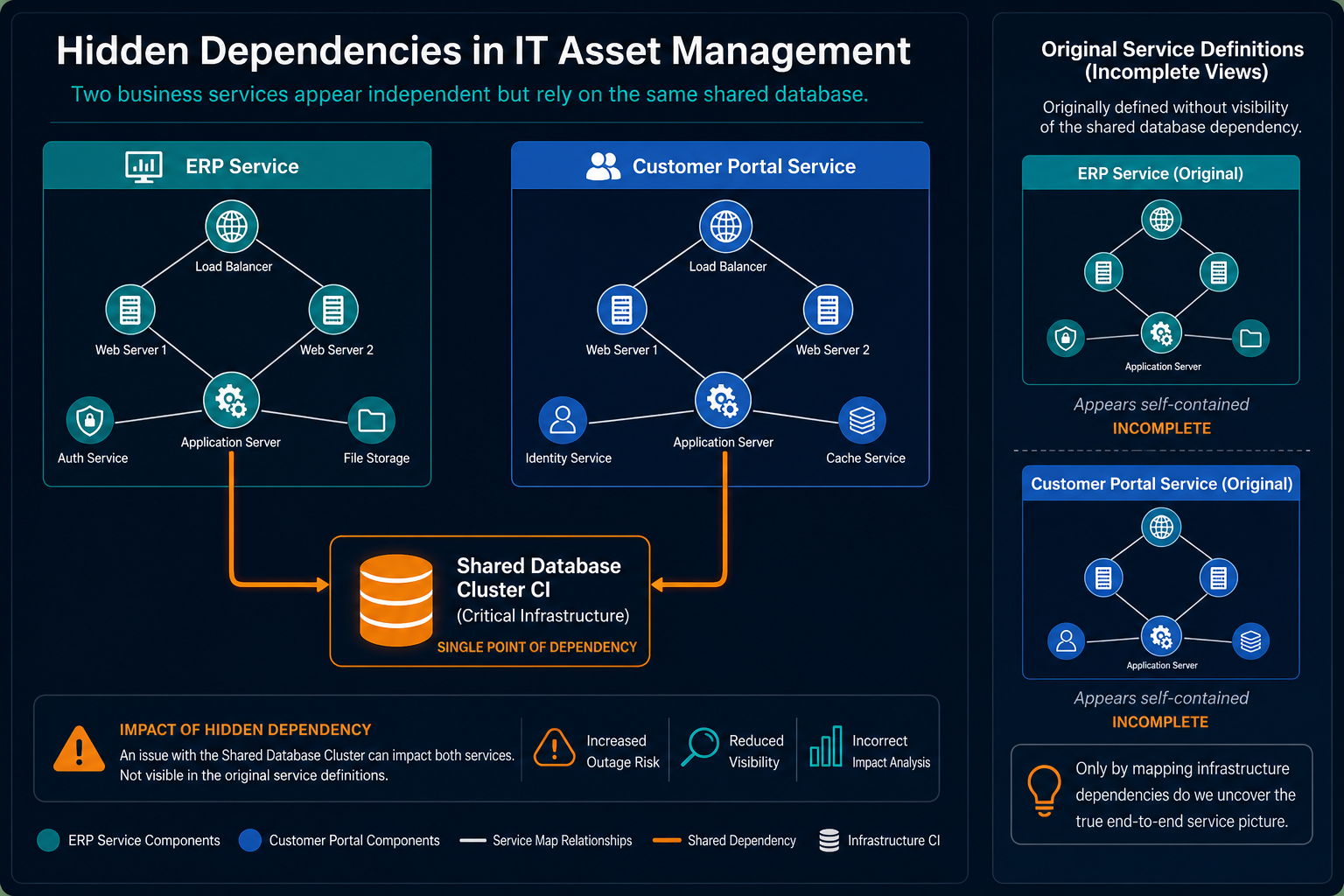
Key insight: A shared database dependency occurs when two or more independent business services connect to the same database cluster or instance, but that shared connection is not documented in either service’s CI records. Discovery-built service maps surface shared database dependencies by mapping active database connections from running application servers, regardless of what service definitions contain.
Why shared infrastructure dependencies go undocumented
Shared database dependencies are among the most persistently undocumented relationships in IT environments. Several forces work together to keep them invisible.
Application teams define services from the application layer down. When an application owner describes their service, they list the application servers they manage, the databases their team provisioned, and the integrations they know about. They do not list databases managed by other teams, even if their application connects to those databases regularly. That ownership model shapes the documentation model — and the gap it creates is structural, not accidental.
Database consolidation happens without service map updates. Organizations consolidate database infrastructure to reduce licensing and hardware costs. When a DBA consolidates two separate database clusters onto one shared cluster, both application teams may receive the new connection string without either team updating their service definitions. That consolidation event — the one that created the shared database dependency — never appears in either service record.
Legacy migrations leave undocumented data dependencies behind. Application migrations move compute layers without always auditing every database connection. A three-year-old data dependency from a migration that predates current team membership is unlikely to appear in any living service definition. Teams inherit what existed without inheriting the documentation of why it exists.
The application owner blind spot
Service definitions reflect what application owners know and manage. Shared infrastructure sits below the application layer and is typically managed by a database, storage, or platform team. The gap between what your application team documents and what the infrastructure team manages creates a documentation void at exactly the layer where dependencies are most dangerous.
This blind spot means shared infrastructure CMDB accuracy cannot be achieved by asking application owners to update their service definitions more thoroughly. They will document what they know. What they do not know — because it is managed by another team, because it predates their tenure, or because it was provisioned through a database consolidation project — will stay undocumented. Discovery is the only structural fix. This aligns with what the EMA ServiceOps 2025 report identifies as a root cause of extended incident response times: missing relationship data at shared infrastructure tiers.
Shared infrastructure dependencies go undocumented because application owners define services from the application layer down and do not document infrastructure managed by other teams. Database consolidation events, legacy migrations, and cross-team resource sharing create dependencies that fall outside any single team’s documentation scope. Discovery finds these dependencies by mapping active connections between running systems — not by relying on team-authored service records.
How discovery-built service maps surface shared dependencies
When Virima’s IT discovery ran across the environment before the scheduled maintenance window, it did not consult either team’s service definition. It scanned the running network, read active database connections from every application server it found, and built a relationship model from what it observed.
The customer portal application servers showed active connections to the database cluster listed in the ERP service definition. The connections ran on port 1433, matched the query patterns of a product catalog schema, and had been active continuously for the three years since the legacy migration. Discovery mapped them as CI relationships: customer portal application server to shared database cluster.
When ViVID™ assembled the service maps from both team service definitions and the discovery-sourced relationship data, the customer portal service map included the shared database cluster as a dependency. The ERP service map included it as well. Both maps showed the same database cluster at the center with connection lines from both application stacks. The shared database dependency appeared in both service maps, in the change impact analysis, and in the blast radius assessment for the maintenance window.
What the database connection map revealed
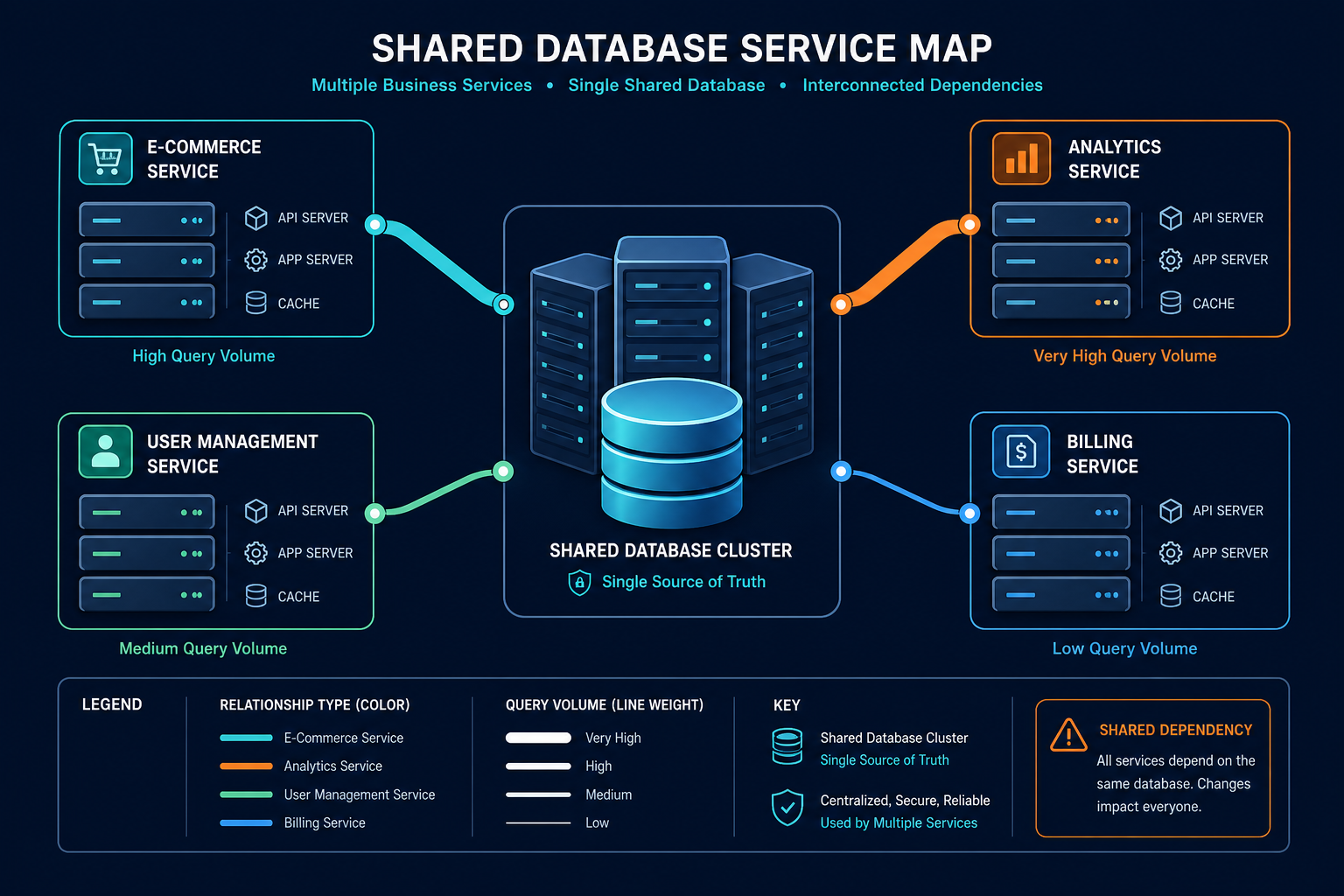
The discovery-sourced relationship map revealed three things the service definitions had not. First, the shared database dependency between the customer portal and the ERP database cluster. Second, a query volume pattern showing that the portal’s product catalog queries represented approximately 40% of the cluster’s read workload during business hours. Third, two other minor services that also wrote to the same cluster during batch processing windows.
The maintenance window planning changed immediately. The change record expanded to list four affected business services. The customer portal team received a maintenance notification and updated their runbook. The batch processing services received notification to reschedule their windows. The CAB re-reviewed the change with complete blast radius information and approved it with an extended post-maintenance validation checklist. The maintenance window completed. All four services recovered on schedule.
What happens when you approve changes without shared dependency data
Change management processes are only as accurate as the CMDB data they run against. When a shared database dependency is absent from the CMDB, change impact analysis produces a false result: it shows one affected service when two or more are at risk. The change advisory board approves based on incomplete blast radius data — blast radius being the full set of services and users a CI change will affect. The teams affected by the undocumented dependency receive no notification.
The operational consequence is an unplanned outage during a planned maintenance window. That category of event generates the most scrutiny because it represents a failure of both the change process and the CMDB simultaneously. An unplanned outage during a planned maintenance window triggers a post-incident review, customer SLA violations, and reputational damage that a complete service map would have prevented. Post-incident reviews almost always trace the root cause to incomplete CI relationship data — missing relationships absent from the CMDB at the time the window was approved. The fix applied is usually a manual CMDB update. The same undocumented shared database dependency will appear in a different form the next time infrastructure is consolidated.
If your change workflows run through ServiceNow or Jira Service Management, the blast radius your CAB sees is only as complete as the CI relationship data Virima’s discovery has populated into your CMDB. Shared infrastructure dependencies that no team documented will be invisible in your change impact analysis until discovery maps the active connections.
Connecting your service mapping process to CMDB auto-discovery is the structural fix. Discovery continuously maps the relationships that exist, not the ones that were documented when the service definitions were written. Shared infrastructure dependencies that no single team knows about appear in the service map because discovery found the connection, not because a team member remembered to add it.
The downstream blast radius nobody calculated
Blast radius analysis in change management depends on the service map it runs against. An incomplete service map produces an incomplete blast radius. When the shared database cluster was absent from the customer portal service definition, the blast radius calculation excluded the customer portal from the scope of the maintenance window. A transaction-processing database serving hundreds of concurrent users was classified as low-risk for a four-hour outage — because one of those user populations was invisible in the impact analysis.
This is the core risk of relying on team-authored service definitions for blast radius assessments. Shared infrastructure belongs to no single team’s service definition and therefore to no team’s blast radius calculation. Discovery-sourced ground truth in service mapping means the blast radius includes everything that will actually be affected, not everything that was documented in a service definition template.
Before your next change window: four questions for shared dependency coverage
If your environment includes database consolidation history, legacy application migrations, or cross-team infrastructure sharing, your current service maps likely have gaps. Before the next change window, your team should be able to answer:
- Does your CMDB relationship map include database clusters managed by teams outside the requesting service owner?
- Has your discovery tool run a connection sweep since your last database consolidation project?
- Are your service definitions updated after infrastructure consolidation events, not just application deployments?
- Does your change impact analysis pull from discovery-sourced relationship data or team-authored service records?
Explore how ViVID™ builds discovery-sourced service maps that include shared infrastructure dependencies at Trusted Runtime Truth resource.
Bottom line: When a shared database dependency is absent from the CMDB, change impact analysis produces a false blast radius that excludes the services depending on the shared tier. Affected teams receive no maintenance notification, and their runbooks do not cover the scenario. Discovery-built service maps fix this by mapping active database connections between running systems, making shared infrastructure dependencies visible before the change window is approved.
Shared dependencies are a discovery problem, not a documentation problem
The customer portal team did not fail to document the shared database dependency because they were careless. They did not know it existed. The dependency predated their involvement with the service, originated from a database consolidation decision made by a different team, and was never surfaced through any service review process. Documentation processes cannot fix what documentation authors do not know.
Discovery fixes it. When Virima maps the active connections between running systems, it finds the shared database cluster in both service maps not because any team listed it but because it was there. The relationship existed in production. Discovery made it visible.
For IT teams managing environments where database consolidation, legacy migrations, and cross-team infrastructure sharing create shared dependencies that nobody planned to document, the service map must come from discovery — not from what teams remember about services they maintain. If you want to build a CMDB page that reflects actual dependencies rather than team knowledge boundaries, start with discovery-sourced relationship mapping.