CI-to-Jira Linking Cut Our Incident Resolution Time by 34%

CI-to-Jira integration connects configuration items from a CMDB directly to incident and service request tickets in Jira, giving responders immediate visibility into affected assets, service owners, and dependency relationships the moment a ticket opens. Virima customers implementing this with accurate, discovery-sourced CI data report 25 to 40 percent reductions in mean time to resolution. Here is what that looked like across 94 incidents tracked over 90 days.
For three consecutive quarters, our average incident resolution time held between 4.5 and 4.9 hours. We retooled runbooks, added escalation paths, and ran post-mortems after every P1. Nothing moved the number. Then we built a CI-to-Jira integration and watched incident resolution time fall to 3.1 hours over the following 90 days. The fix was not in our process. It was in what our responders could see the moment a ticket opened.
What was missing from every ticket
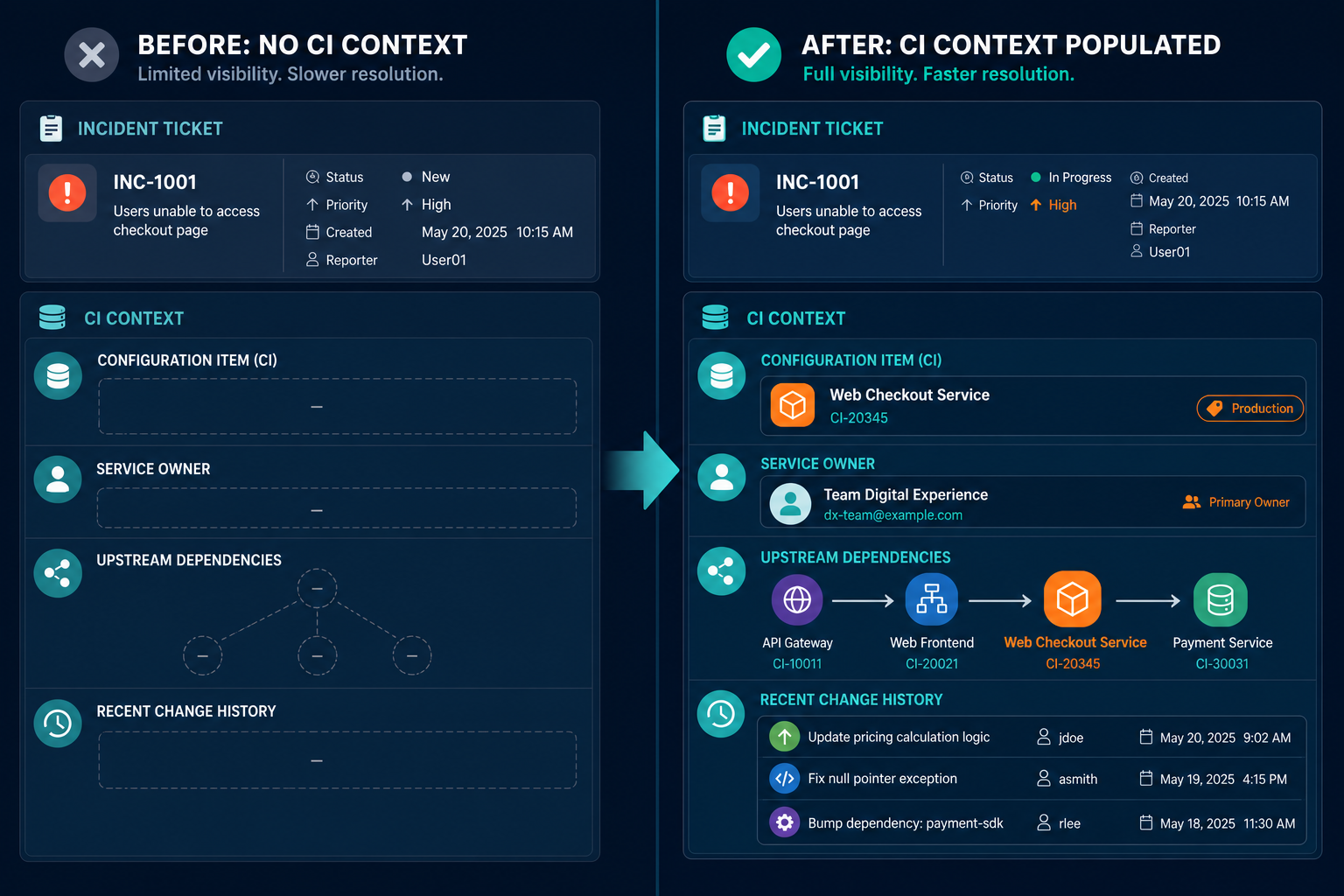
When an incident opened in Jira, our responders received: a description, a severity label, and the name of whoever filed it. No affected CI. No service context. No upstream dependencies. No owner. Every ticket started from scratch.
We reviewed 312 incident tickets from January through March. Of those, 244 (78%) had no CI attached. Responders were spending an average of 47 minutes per incident answering a single question: what is actually broken? Only after identifying the affected asset could they begin diagnosing the cause.
That 47-minute identification window was our biggest hidden cost. In a P1, it is the difference between a 3-hour resolution and a 6-hour war room. We were paying it on nearly every ticket.
The CMDB data that was already there
Our CMDB held 8,400 configuration items at the time — servers, network devices, databases, middleware, and cloud instances. Each CI had an owner, a service association, related CIs, and a history of recent changes. The data existed. It remained disconnected from Jira.
When we assessed coverage, we found that 91% of the incident tickets filed in Q1 involved CIs already present in our CMDB. The asset data was there. Responders had no path to reach it from inside the ticket.
Our Jira Service Management integration mapped CI relationships to incident tickets based on affected service, hostname, and IP address. Responders could now open a ticket and immediately see which CI was involved, who owned it, what services depended on it, and what changes had occurred in the prior 72 hours.
What changed for responders
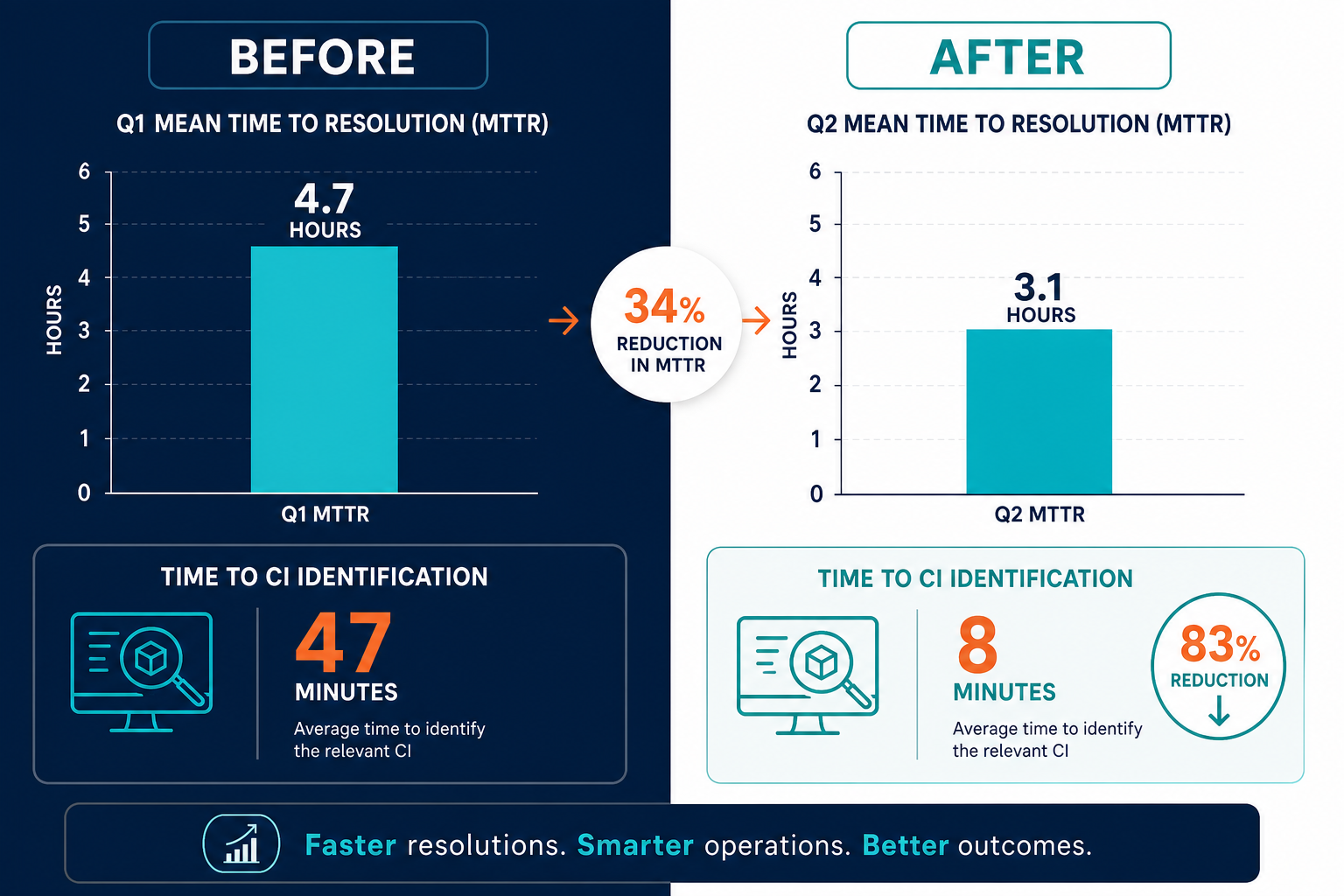
The first thing we measured was time-to-CI-identification. Before the integration, the average across our 14-person IT operations team was 47 minutes. After the first 30 days, that number dropped to 8 minutes. That single change accounted for the majority of our overall MTTR improvement.
The second change was subtler. With CI context in the ticket, responders stopped re-investigating the same infrastructure repeatedly. Before the integration, we had three incidents over six months each caused by the same misconfigured middleware layer. Each was triaged independently, each took over 4 hours, and none was ever connected to the others because no CI was recorded in any of the three tickets. Post-integration, when a similar incident opened, Jira surfaced the CI record and a responder immediately found the earlier tickets referencing the same component.
That pattern of disconnected repeat incidents disappears once every ticket is anchored to a live, discovery-sourced CI record. The combination of automated discovery-sourced CI records and ViVID™ service maps is what separates a CMDB integration from a CMDB-and-dependency integration — and why we saw two proactive interventions in Q2 that would otherwise have become a second P1.
The 90-day numbers
We tracked MTTR across 94 incidents from April through June:
- Average MTTR in Q1 (baseline): 4.7 hours
- Average MTTR in Q2 (post-integration): 3.1 hours
- MTTR reduction: 34%
- Time-to-CI-identification: fell from 47 minutes to 8 minutes
- Incidents with CI context attached: rose from 22% to 89%
The 11% of tickets still lacking full CI context were cloud-native workloads outside our current IT discovery scope, or third-party SaaS tools with no internal CI record. That gap went on our backlog.
How CI-to-Jira integration changed how responders work
The data shift changed how people actually worked. Before, responders defaulted to asking around: Slack messages to ops, Teams calls to infrastructure, emails to the service desk. The human network was the CI lookup tool.
After the integration, 82% of that lateral communication dropped in the first month. Responders had answers in the ticket. They escalated to people for decisions, not for basic data. Engineering time shifted from “tell me what this CI is connected to” toward “here’s what I see, and here’s my proposed fix.”
For directors tracking team utilization, this is material. Fourteen engineers across ops and ITSM were collectively spending an estimated 11 hours per week on manual CI identification. That number fell to under 2 hours per week within 60 days.
The discovery layer that made it possible
The integration only works if the CI data is trustworthy. A connection to a stale CMDB does not reduce MTTR. It shifts the problem: responders see CI records that are months out of date and either distrust the data or act on wrong information.
Our CMDB data quality was the prerequisite we almost skipped. We ran a full CMDB audit in March before enabling the Jira connection. We found 1,247 CIs with ownership fields that were blank or pointed to employees who had left the company. We found 318 CIs with service associations that predated a 2024 infrastructure reorganization.
Fixing that data took three weeks. It was not glamorous work. But it was the reason the integration produced results instead of adding noise to every ticket.
The sequence matters: build a CMDB you trust first, then connect it to your ticketing system. Following CMDB best practices before the integration was the decision that made the 34% improvement possible. If your CMDB is the bottleneck, that guide covers the ownership and service association audit that should precede the integration. For teams ready to see discovery-sourced CI data in action, explore how Trusted Runtime Truth connects CI accuracy to every incident ticket.
What the ViVID™ maps added
Beyond the basic CI field in the ticket, our team also connected ViVID™ service maps to Jira incidents. When a P1 opened, responders could pull up a dependency map of the affected service and see which CIs were upstream, which showed active incidents, and which had change records in the prior 48 hours.
This shifted us from reactive triage to blast radius thinking. Instead of asking “what’s broken,” responders could ask “what else is at risk.” In two separate incidents during Q2, the map view identified secondary components already degrading before they failed, allowing proactive intervention rather than a second P1.
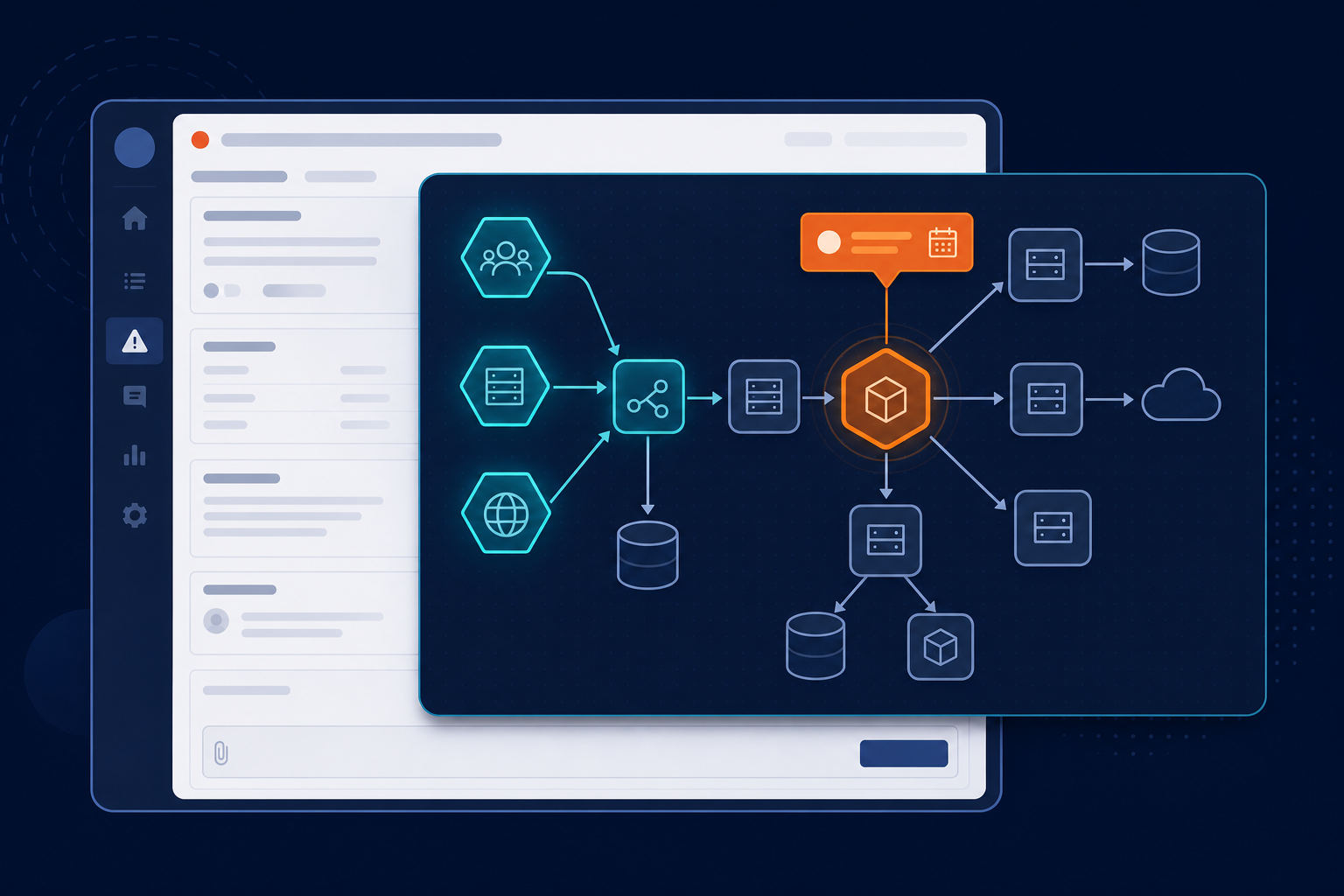
That is what Trusted Runtime Truth looks like in practice — not a reporting dashboard, but a working system where every incident starts from accurate, current CI data.
What we would do differently
Three things we would change if we ran this project again:
- Start the data quality audit earlier. We lost three weeks of potential MTTR improvement because we waited to clean the CMDB until we were ready to connect it. The audit should precede the integration design, not follow it.
- Define CI ownership standards before the integration, not after. We had 14 different formats for recording CI owners across our 8,400-item CMDB. Normalizing that took longer than the technical integration itself.
- Involve responders in the design phase. The way we initially structured CI context in the Jira ticket made sense to the CMDB team but did not match how responders naturally searched for information. A two-day working session with four of our ITSM engineers before launch would have saved two weeks of post-launch iteration.
If your team is running incidents out of Jira Service Management without CI context, you are paying the same 47-minute identification tax. Start with the data quality foundation: CMDB best practices covers the ownership and service association audit that made our 34% improvement possible. When you are ready to see the integration in a live environment, schedule a demo with Virima.